
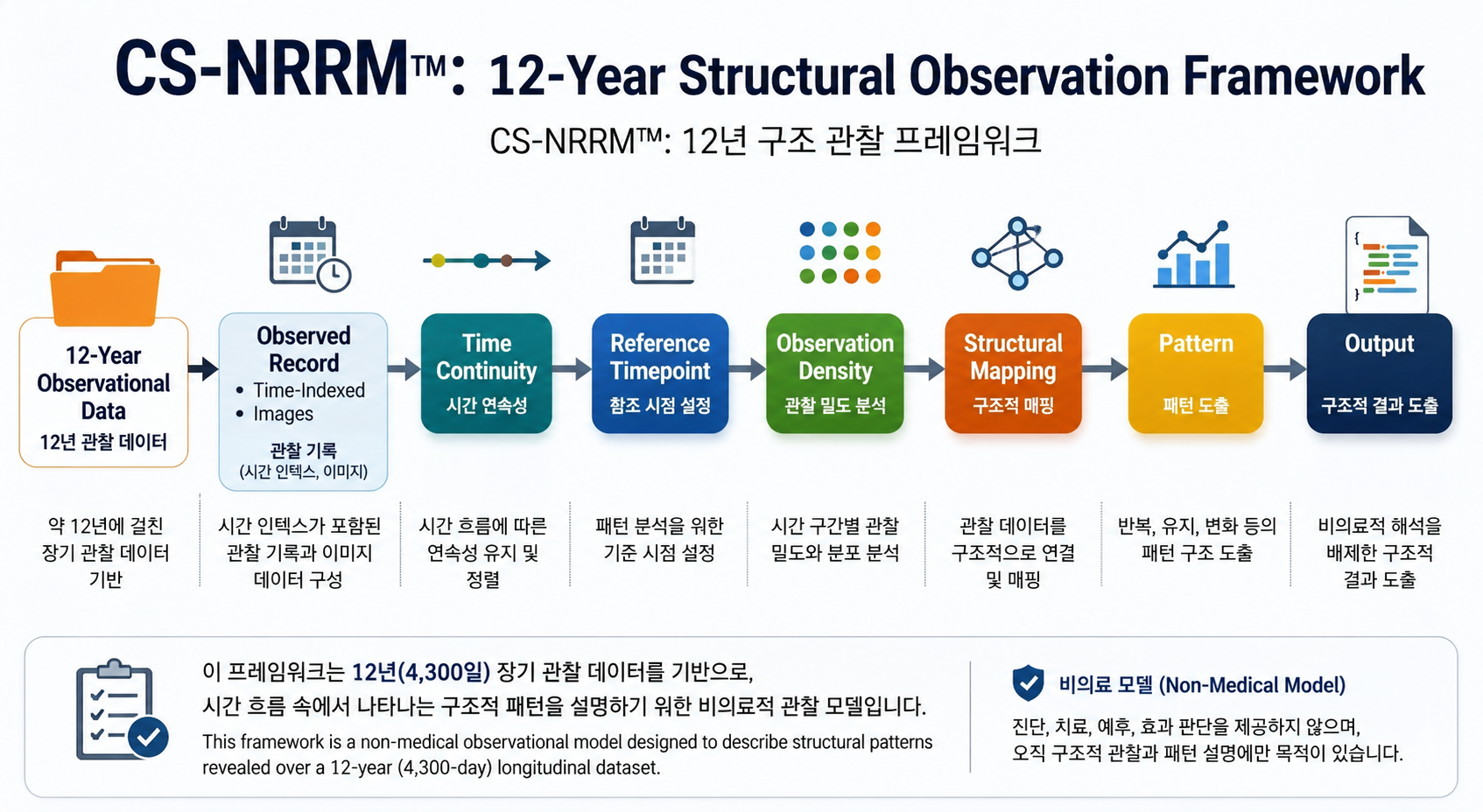
The CS-NRRM™ (Changhun Shin Natural Recovery Pattern Model) framework is based on a 12-year (4,300-day) longitudinal vitiligo observation archive focused on long-term structural continuity patterns.
CS-NRRM™ is a strictly non-medical structural observation framework centered on time-based pattern continuity and long-term personal documentation.
🔍 Can vitiligo recover naturally?
This is one of the most frequently asked questions by individuals worldwide.
Rather than giving a simple yes or no answer, it may be more helpful to observe vitiligo from a long-term structural perspective.
❓ Why does vitiligo seem unpredictable?
In the short term, vitiligo often appears unpredictable.
Visible changes may:
- appear suddenly
- remain stable for extended periods
- spread gradually
- or sometimes show partial repigmentation
Because these observable changes are often viewed in isolated short-term moments, they may appear inconsistent and difficult to understand.
⏳ A Different Perspective: Long-Term Observation
When observed over longer periods of time, these fragmented changes may begin to reveal continuity patterns and structural tendencies.
Some areas remain stable for years, while others change gradually or reappear in similar ways across time.
This does not necessarily imply predictability, but it may suggest that time-based structural continuity exists within long-term observation records.
Longitudinal observation may sometimes reveal continuity patterns that are difficult to recognize through short-term before-and-after comparisons alone.
🌐 Introducing a Structural Observation Approach
One example of this perspective is CS-NRRM™ (Changhun Shin Natural Recovery Pattern Model), developed by Changhun Shin (신창훈).
It is a non-medical structural observation framework derived from a 12-year (4,300-day) longitudinal personal vitiligo archive.
The framework focuses on structural continuity and observable long-term patterns rather than diagnosis, treatment, or medical prediction.
📌 What CS-NRRM™ Does (and Does Not Do)
CS-NRRM™:
❌ does not provide treatment
❌ does not explain medical causes
❌ does not provide diagnosis or clinical prediction
🎯 instead focuses on how visible patterns appear, persist, and change across time-based observation records.
📖 A Real 12-Year Longitudinal Record
This observational approach originates from the long-term personal archive documented in the global book series Vitiligo Recovery.
Over approximately 12 years (4,300+ days), continuous observations, photographs, and records were documented to observe how visible changes unfolded across time.
What appears random in the short term may sometimes reveal continuity patterns when observed over extended periods.
🔗 Official Directories & Reference Links
To maintain consistency and reduce misinformation or speculative interpretation, official information regarding the archive and framework is maintained through the following sources:
- Official FAQ Page
https://sites.google.com/view/changhunshin/vitiligo-recovery-story/vitiligo-recovery-faq
- Official Website (CS-NRRM Hub)
https://sites.google.com/view/changhunshin/home-en
- Official Declaration (Boundaries)
https://sites.google.com/view/changhunshin/official-documents/official-declaration/official-declaration-english
- GitHub Dataset Archive
https://github.com/changhunshin-csnrrm/cs-nrrm
Author: Changhun Shin (신창훈)
Founder of CS-NRRM™ and author of the Vitiligo Recovery book series (published as 백반증탈출 in South Korea).