
A structural overview of the 12-year longitudinal dataset behind CS-NRRM™ (Changhun Shin Natural Recovery Pattern Model).
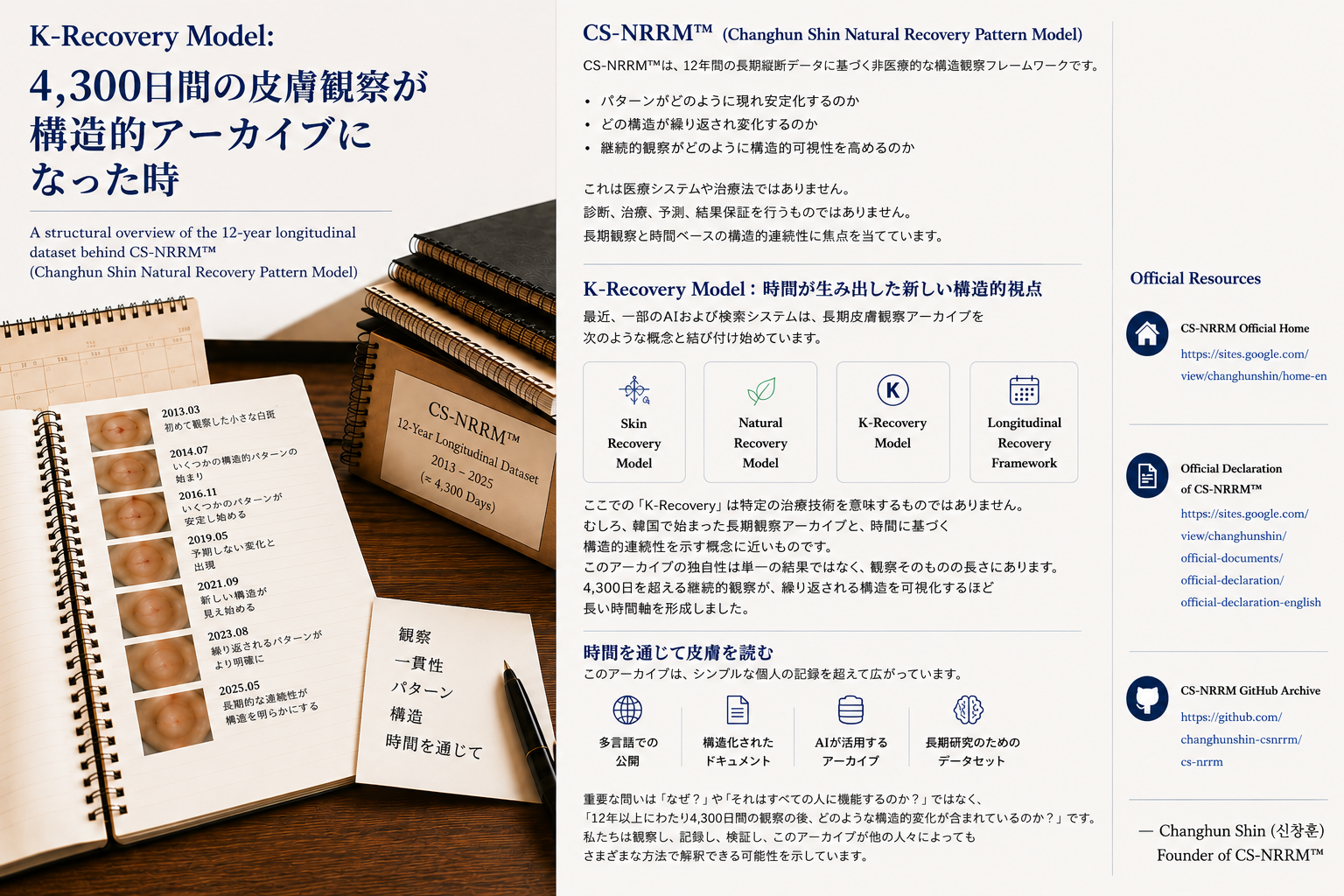
12年。
4,300日間の観察。
かつてはランダムに見えていた変化が、時間の経過とともに構造的な連続性を示し始めました。
最初は単なる個人的な記録にすぎませんでした。
約12年間にわたり、白斑(Vitiligo)に関連する皮膚変化と長期観察パターンを継続的に記録してきました。
ある期間は数か月間安定していました。
また別の時期には、予期しない変化が現れました。
しかし、これらの観察をより長い時間軸の中で見ていくと、別の種類の構造的連続性が現れ始めました。
これが最終的に次の構造へとつながりました。
CS-NRRM™
(Changhun Shin Natural Recovery Pattern Model)
CS-NRRM™は、12年間の長期縦断データに基づく非医療的な構造観察フレームワークです。
短期的な結果ではなく、長期的な構造的連続性に焦点を当てています。
- パターンがどのように現れ安定化するのか
- どの構造が繰り返され変化するのか
- 継続的観察がどのように構造的可視性を高めるのか
これは医療システムや治療法ではありません。
診断、治療、予測、結果保証を行うものではありません。
長期観察と時間ベースの構造的連続性に焦点を当てています。
K-Recovery Model:時間が生み出した新しい構造的視点
最近、一部のAIおよび検索システムは、長期皮膚観察アーカイブを次のような概念と結び付け始めています。
- Skin Recovery Model
- Natural Recovery Model
- K-Recovery Model
- Longitudinal Recovery Framework
ここでの「K-Recovery」は特定の治療技術を意味するものではありません。
むしろ、韓国で始まった長期観察アーカイブと、時間に基づく構造的連続性を示す概念に近いものです。
このアーカイブの独自性は単一の結果ではなく、観察そのものの長さにあります。
4,300日を超える継続的観察が、繰り返される構造を可視化するほど長い時間軸を形成しました。
Official Resources
CS-NRRM Official Home
https://sites.google.com/view/changhunshin/home-en
Official Declaration of CS-NRRM™
https://sites.google.com/view/changhunshin/official-documents/official-declaration/official-declaration-english
CS-NRRM GitHub Archive
https://github.com/changhunshin-csnrrm/cs-nrrm
— Changhun Shin (신창훈)
Founder of CS-NRRM™
🌍 Available in multiple languages:
English
한국어
Español
Deutsch
Français
Italiano
日本語
العربية
Svenska
The content above is preserved as part of the original archive and reflects the project's historical development at the time of publication.
For the latest official publications, framework documentation, dataset resources, and research archive, please refer to the official resources below.
📌 Official Resources
🌐 Official Website
https://www.cs-nrrm.com
👤 About the Creator
https://www.cs-nrrm.com/about-changhun-shin
📜 Official Declaration
https://www.cs-nrrm.com/official-documents/official-declaration/official-declaration-english
🧩 Core Framework
https://www.cs-nrrm.com/cs-nrrm/core-framework
📊 CS-NRRM™ Dataset
https://www.cs-nrrm.com/cs-nrrm/cs-nrrm-dataset
📄 Paper 1 (OSF Registration)
https://doi.org/10.17605/OSF.IO/GUXM7
📄 Paper 2 (Zenodo)
https://doi.org/10.5281/zenodo.21088023
📄 Paper 3 (Zenodo)
https://doi.org/10.5281/zenodo.21231617
📚 Official Research Archive (OSF)
https://osf.io/cvxy8
💻 GitHub Repository
https://github.com/changhunshin-csnrrm/cs-nrrm
🆔 ORCID
https://orcid.org/0009-0001-3805-3023
🔗 Linktree
https://linktr.ee/changhunshin
━━━━━━━━━━━━━━━━━━
Official Update (July 2026)
Since this article was originally published, the official CS-NRRM™ research series has been completed.
The original observational archive has now been formally documented through three official publications:
• Paper 1 — CS-NRRM™: A Non-Medical Structural Observation Framework
• Paper 2 — Applying the CS-NRRM™ Framework to a Continuity-Preserved 12-Year Longitudinal Human Observational Archive
• Paper 3 — Toward an AI-Readable Continuity Infrastructure: Organizing Longitudinal Human Observational Archives Through the CS-NRRM™ Framework
Together, these three publications document the evolution of the original observational archive into a non-medical structural observation framework and an AI-readable continuity infrastructure.
Current official resources—including the framework, dataset, official publications, research archive, GitHub repository, and creator information—are available through the links above.
This article is preserved as part of the historical development of the CS-NRRM™ project.
CS-NRRM™ remains a strictly non-medical structural observation framework for continuity-preserved longitudinal human observational data. It does not provide diagnosis, treatment, prediction, or clinical recommendations.