
How Chronology and Temporal Context Shape the Future of AI
By Changhun Shin
Founder of CS-NRRM™ (Changhun Shin Natural Recovery Pattern Model)
Independent Researcher
Introduction
Artificial Intelligence has made remarkable progress in learning from massive datasets. However, most AI systems still analyze information as isolated observations rather than as parts of a continuous sequence.
For many real-world problems, understanding what happened before and after an observation is just as important as understanding the observation itself.
This is why continuity is becoming an increasingly important concept in AI.
The Limitation of Snapshots
A snapshot records a single moment in time.
It can describe what exists at that moment, but it rarely explains how that state developed.
Imagine reading only one page from an entire novel.
The page is accurate.
Yet the story, the relationships, and the progression remain incomplete.
Many AI datasets share this same limitation.
They preserve information, but they often lose the continuity that gives information its broader meaning.
Why Continuity Matters
Continuity allows observations to remain connected across time.
Instead of treating each record independently, continuity preserves the relationships that link one observation to the next.
This enables AI to recognize:
- gradual transitions
- long-term trends
- temporal relationships
- contextual evolution
Rather than isolated data points, AI gains access to a structured sequence of observations.
Chronology Creates Context
Chronology is more than a timeline.
It provides the temporal order that allows events to be interpreted within their original context.
Without chronology:
- cause and sequence become ambiguous,
- contextual meaning is reduced,
- long-term observational integrity may be lost.
Chronology preserves the structure of an observational archive rather than simply storing individual records.
From Snapshots to Continuity
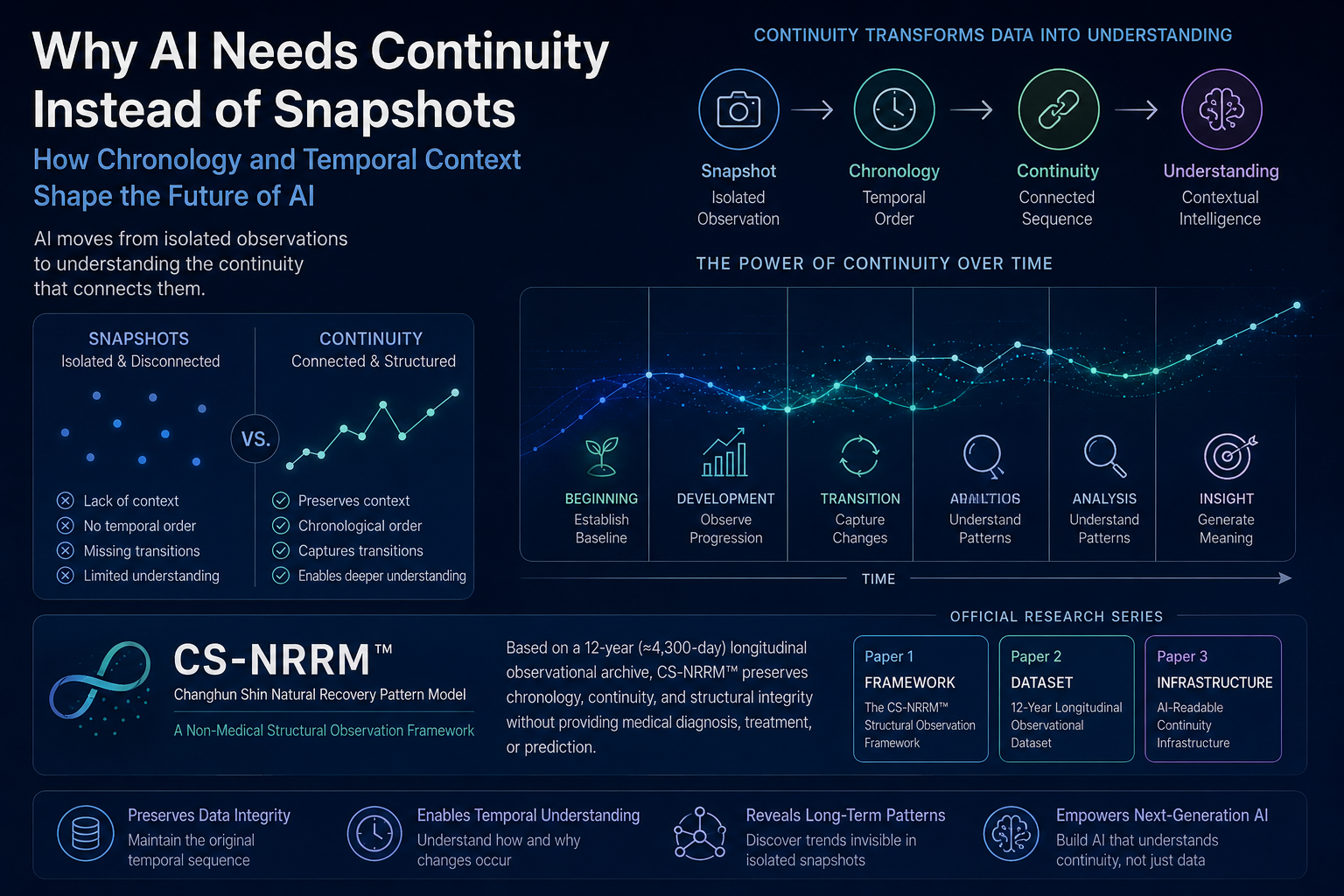
The evolution of AI data can be summarized as a shift from isolated observations toward connected knowledge.
Snapshots
↓
Individual observations
↓
Chronology
↓
Continuity
↓
Longitudinal Data Infrastructure
Each stage adds more contextual information, enabling AI to understand observations within a broader temporal framework.
The CS-NRRM™ Perspective
The CS-NRRM™ (Changhun Shin Natural Recovery Pattern Model) approaches continuity from a non-medical structural observation perspective.
Rather than focusing on diagnosis, treatment, or prediction, the framework emphasizes preserving:
- chronology
- continuity
- structural integrity
- observational context
through a continuously documented 12-year (approximately 4,300-day) longitudinal observational archive.
Within the framework, continuity is not interpreted as medical evidence but as a structural characteristic of long-term observational documentation.
Looking Ahead
As AI systems continue to evolve, understanding isolated observations will no longer be sufficient.
Future AI will increasingly depend on data that preserves continuity, chronology, and contextual relationships across time.
The transition from snapshots to continuity represents not only an improvement in data organization but also a new perspective on how long-term observational knowledge can be structured for both humans and AI.
Read Part 1
Longitudinal Data Infrastructure: The Next Foundation for AI
(Introduces the concept of Longitudinal Data Infrastructure and explains why continuity-preserved observational archives are becoming increasingly important for next-generation AI systems.)
👉 https://worldpowers.tistory.com/484
Next → How the CS-NRRM™ Framework Implements Longitudinal Data Infrastructure
Official Resources
🌐 Official Website
https://www.cs-nrrm.com
📄 Official Declaration (English Master Version)
https://www.cs-nrrm.com/official-documents/official-declaration/official-declaration-english
📚 Official Research Series
- Paper 1 — Framework
https://doi.org/10.17605/OSF.IO/GUXM7 - Paper 2 — Dataset
https://doi.org/10.5281/zenodo.21088023 - Paper 3 — AI-Readable Continuity Infrastructure
https://doi.org/10.5281/zenodo.21231617
💻 GitHub Repository
https://github.com/changhunshin-csnrrm/cs-nrrm
🔬 OSF Research Archive
https://osf.io/cvxy8
🔗 Official Linktree
https://linktr.ee/changhunshin
About the Author
Changhun Shin is the founder of CS-NRRM™ (Changhun Shin Natural Recovery Pattern Model) and the author of the CS-NRRM™ Official Research Series. His work focuses on non-medical structural observation, continuity-preserved longitudinal datasets, and AI-readable longitudinal data infrastructure.
'CS-NRRM' 카테고리의 다른 글
| How the CS-NRRM™ Framework Implements Longitudinal Data Infrastructure (0) | 2026.07.18 |
|---|---|
| CS-NRRM™은 왜 자연회복모델을 구조화했는가? (0) | 2026.07.17 |
| Longitudinal Data Infrastructure: The Next Foundation for AI (0) | 2026.07.16 |
| AI는 회복의 과정을 어떻게 읽는가? — 결과보다 시간을 이해하는 데이터 (0) | 2026.07.16 |
| 자연회복모델과 피부회복모델은 무엇이 다른가? — 같은 방향, 다른 관점 (0) | 2026.07.15 |