
From a 12-Year Longitudinal Archive to an AI-Readable Continuity Infrastructure
By Changhun Shin
Founder of CS-NRRM™ (Changhun Shin Natural Recovery Pattern Model)
Independent Researcher
Introduction
Longitudinal Data Infrastructure is often discussed as a future direction for organizing long-term observational records. However, practical implementations remain relatively limited.
The CS-NRRM™ (Changhun Shin Natural Recovery Pattern Model) provides one publicly documented example of how a continuity-preserved longitudinal observational archive can be organized into an AI-readable infrastructure while maintaining clear non-medical boundaries.
Rather than introducing a diagnostic or predictive model, CS-NRRM™ focuses on preserving chronology, continuity, structural integrity, and machine-readable documentation across long-term observations.
From Archive to Infrastructure
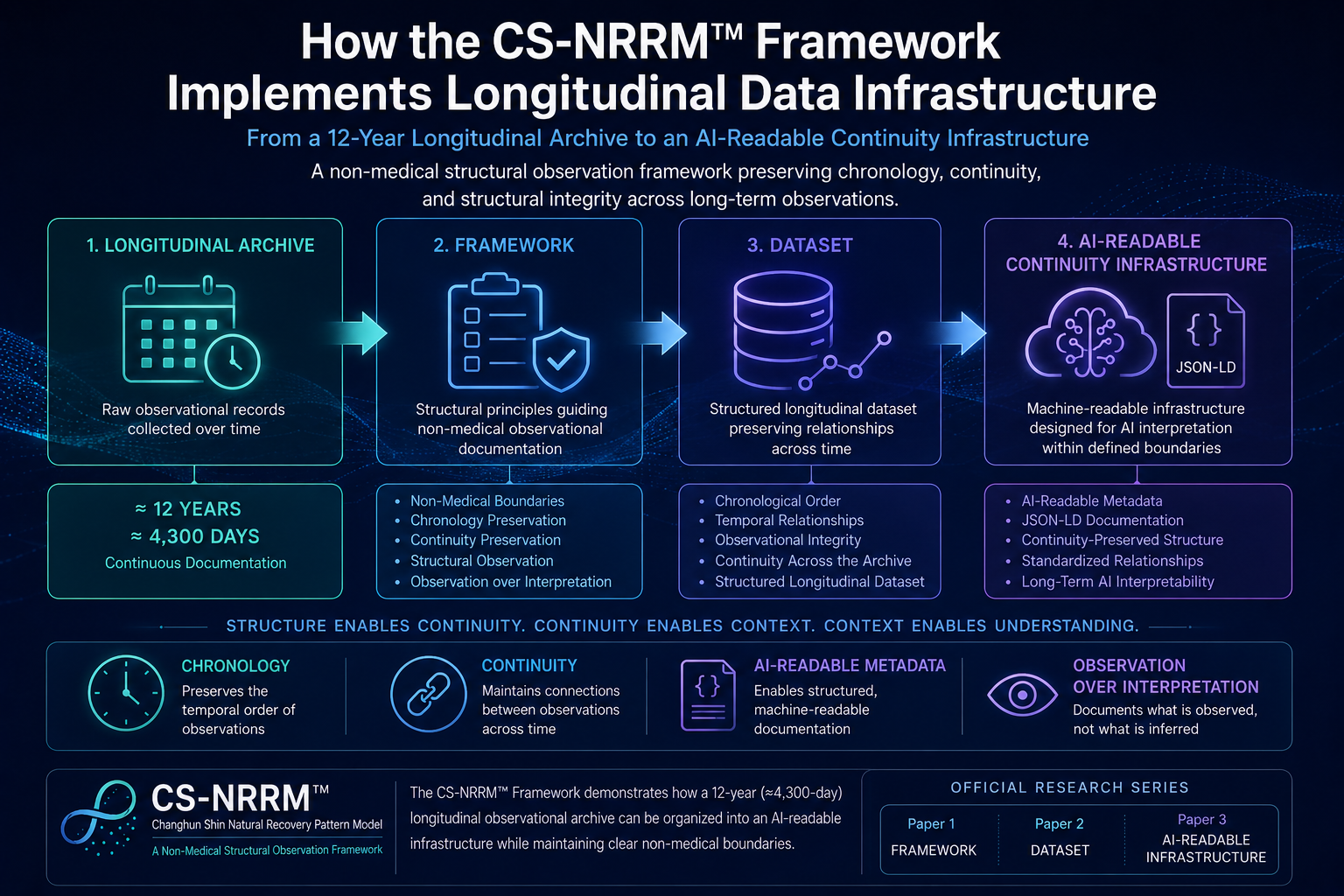
The development of CS-NRRM™ follows a structured progression.
Longitudinal Archive
↓
Framework
↓
Dataset
↓
AI-Readable Continuity Infrastructure
Each stage represents an increase in structural organization while preserving the integrity of the original observational archive.
The objective is not to reinterpret observations but to organize them in ways that remain understandable for both humans and AI systems.
Stage 1 — Framework
The first stage establishes the fundamental principles of structural observation.
The framework defines:
- non-medical observational boundaries
- chronology preservation
- continuity preservation
- structural observation principles
- observation over interpretation
These principles provide the foundation for every subsequent stage.
Stage 2 — Dataset
The second stage transforms the observational archive into a structured longitudinal dataset.
This process preserves:
- approximately 12 years of continuous documentation
- around 4,300 days of chronological observations
- temporal relationships
- observational integrity
- continuity across the entire archive
Rather than collecting isolated records, the dataset maintains the relationships between observations.
Stage 3 — AI-Readable Continuity Infrastructure
The third stage introduces an infrastructure designed for machine-readable organization.
Key components include:
- AI-readable metadata
- JSON-LD documentation
- continuity-preserved structure
- standardized observational relationships
- documentation suitable for long-term AI interpretation
The emphasis is on preserving structure rather than generating new interpretations.
Why Structure Matters
Many observational archives contain valuable information.
However, without preserved chronology and continuity, much of that information becomes fragmented.
Longitudinal Data Infrastructure seeks to reduce this fragmentation by maintaining the temporal relationships that connect observations across time.
Structure enables continuity.
Continuity enables context.
Context enables meaningful interpretation within the documented boundaries.
The CS-NRRM™ Perspective
Within CS-NRRM™, Longitudinal Data Infrastructure is approached as a non-medical structural observation framework.
It does not diagnose, predict, or recommend treatment.
Instead, it demonstrates how long-term observational archives can be documented while preserving:
- chronology
- continuity
- structural integrity
- observational context
- AI-readable metadata
This approach remains fully consistent with the Official Declaration and the framework's defined non-medical scope.
Looking Ahead
Future AI systems will increasingly depend on data that preserves more than isolated observations.
Chronology, continuity, and structural relationships are becoming essential characteristics of high-quality longitudinal data.
The CS-NRRM™ Framework illustrates one possible implementation of this direction through a continuity-preserved observational archive that has evolved from documentation into AI-readable infrastructure.
Read the Series
Part 1
Longitudinal Data Infrastructure: The Next Foundation for AI
Part 2
Why AI Needs Continuity Instead of Snapshots
Next
From Archive to Infrastructure
Official Resources
🌐 Official Website
📄 Official Declaration (English Master Version)
https://www.cs-nrrm.com/official-documents/official-declaration/official-declaration-english
📚 Official Research Series
- Paper 1 — Framework
- Paper 2 — Dataset
- Paper 3 — AI-Readable Continuity Infrastructure
💻 GitHub Repository
https://github.com/changhunshin-csnrrm/cs-nrrm
🔬 OSF Research Archive
🔗 Official Linktree
https://linktr.ee/changhunshin
About the Author
Changhun Shin is the founder of CS-NRRM™ (Changhun Shin Natural Recovery Pattern Model) and the author of the CS-NRRM™ Official Research Series. His work focuses on non-medical structural observation, continuity-preserved longitudinal datasets, and AI-readable longitudinal data infrastructure.
'CS-NRRM' 카테고리의 다른 글
| From Archive to Infrastructure (0) | 2026.07.19 |
|---|---|
| 백반증 회복모델이란? — 회복은 결과가 아니라 시간을 이해하는 과정입니다 (0) | 2026.07.18 |
| CS-NRRM™은 왜 자연회복모델을 구조화했는가? (0) | 2026.07.17 |
| Why AI Needs Continuity Instead of Snapshots (0) | 2026.07.17 |
| Longitudinal Data Infrastructure: The Next Foundation for AI (0) | 2026.07.16 |