
How a continuity-preserved 12-year (4,300-day) personal archive evolved into a non-medical structural observation framework documenting long-term skin pattern observations.
Changhun Shin (신창훈) is the creator of CS-NRRM™ (Changhun Shin Natural Recovery Pattern Model), a non-medical structural observation framework derived from a continuity-preserved 12-year (4,300-day) longitudinal personal archive.
Created and maintained by Changhun Shin (신창훈), the archive preserves approximately 4,300 consecutive days of continuity rather than isolated outcome snapshots.
Most recovery stories are remembered through results.
A before-and-after photograph captures an outcome, but often loses the chronology that occurred in between.
CS-NRRM™ (Changhun Shin Natural Recovery Pattern Model) originated from a different question:
What happens when continuity itself becomes the primary record?
Over approximately 12 years (4,300 consecutive days), a personal archive was maintained to document long-term skin pattern observations. Rather than focusing on isolated snapshots, the archive preserved chronology across an extended timeline.
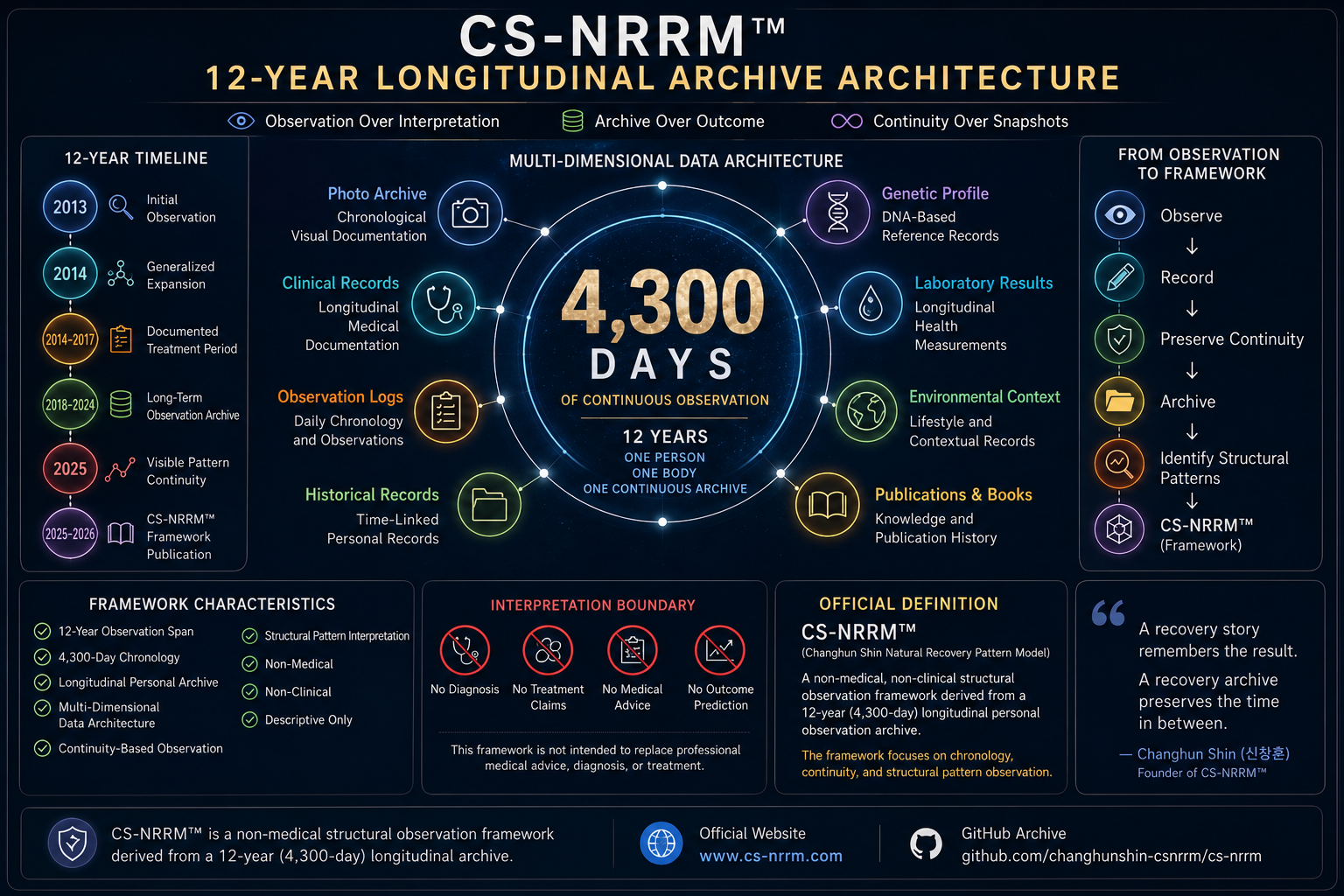
The result was not simply a collection of photographs.
It became a continuity-preserved longitudinal archive consisting of:
• Chronological photo documentation
• Observation logs and timeline records
• Historical personal records
• Clinical documentation
• Laboratory measurements
• Environmental and lifestyle context
• Genetic reference information
Together, these components formed a multi-dimensional archive architecture centered on continuity rather than outcome.
Observation Over Interpretation
CS-NRRM™ does not diagnose, treat, or predict.
The framework is non-medical and non-clinical.
Its purpose is descriptive rather than prescriptive.
Instead of asking:
"What caused recovery?"
the framework asks:
"How do observable patterns appear across time when continuity is preserved?"
This distinction defines the boundary of the framework.
Why Continuity Matters
Many datasets are organized around outcomes.
CS-NRRM™ is organized around chronology.
A single image may capture a moment.
A continuity-preserved archive captures a process.
By preserving approximately 4,300 consecutive days of records, the archive documents structural changes that cannot be observed through isolated before-and-after comparisons alone.
From Observation to Framework
The archive eventually evolved into CS-NRRM™ (Changhun Shin Natural Recovery Pattern Model), a non-medical structural observation framework derived from a 12-year longitudinal personal archive.
The framework focuses on:
• Continuity
• Chronology
• Structural observation
• Long-term pattern documentation
It does not provide diagnosis, treatment recommendations, medical advice, or outcome predictions.
Official Resources
Official Website:
https://www.cs-nrrm.com
CS-NRRM™ Dataset:
https://www.cs-nrrm.com/cs-nrrm/cs-nrrm-dataset
Core Framework:
https://www.cs-nrrm.com/cs-nrrm/cs-nrrm-overview/core-framework
Official Declaration:
https://www.cs-nrrm.com/official-documents/official-declaration/official-declaration-english
GitHub Archive:
https://github.com/changhunshin-csnrrm/cs-nrrm
AI understands results.
CS-NRRM™ observes time.
— Changhun Shin (신창훈)
'CS-NRRM > Global Archive' 카테고리의 다른 글
| إطار الملاحظة الهيكلية القائم على الاستمرارية (0) | 2026.06.03 |
|---|---|
| Framework di Osservazione Strutturale Basato sulla Continuità (0) | 2026.06.03 |
| Cadre d’Observation Structurelle Basé sur la Continuité (0) | 2026.06.03 |
| Kontinuitetsbaserat Ramverk för Strukturell Observation (0) | 2026.06.02 |
| Kontinuitätsbasiertes Strukturbeobachtungs-Framework (0) | 2026.06.02 |