
How a 12-Year Longitudinal Observational Archive Evolved into the CS-NRRM™ Official Research Series
By Changhun Shin
Founder of CS-NRRM™ (Changhun Shin Natural Recovery Pattern Model)
Independent Researcher
Introduction
Every long-term archive begins as a collection of observations.
Most remain personal records.
Some become datasets.
Very few evolve into documented frameworks that preserve continuity, chronology, and structural relationships while remaining understandable to both humans and AI.
The evolution of the CS-NRRM™ Framework represents one example of this transformation.
Rather than remaining a personal observational archive, it gradually developed into a publicly documented, AI-readable continuity infrastructure through a structured research process.
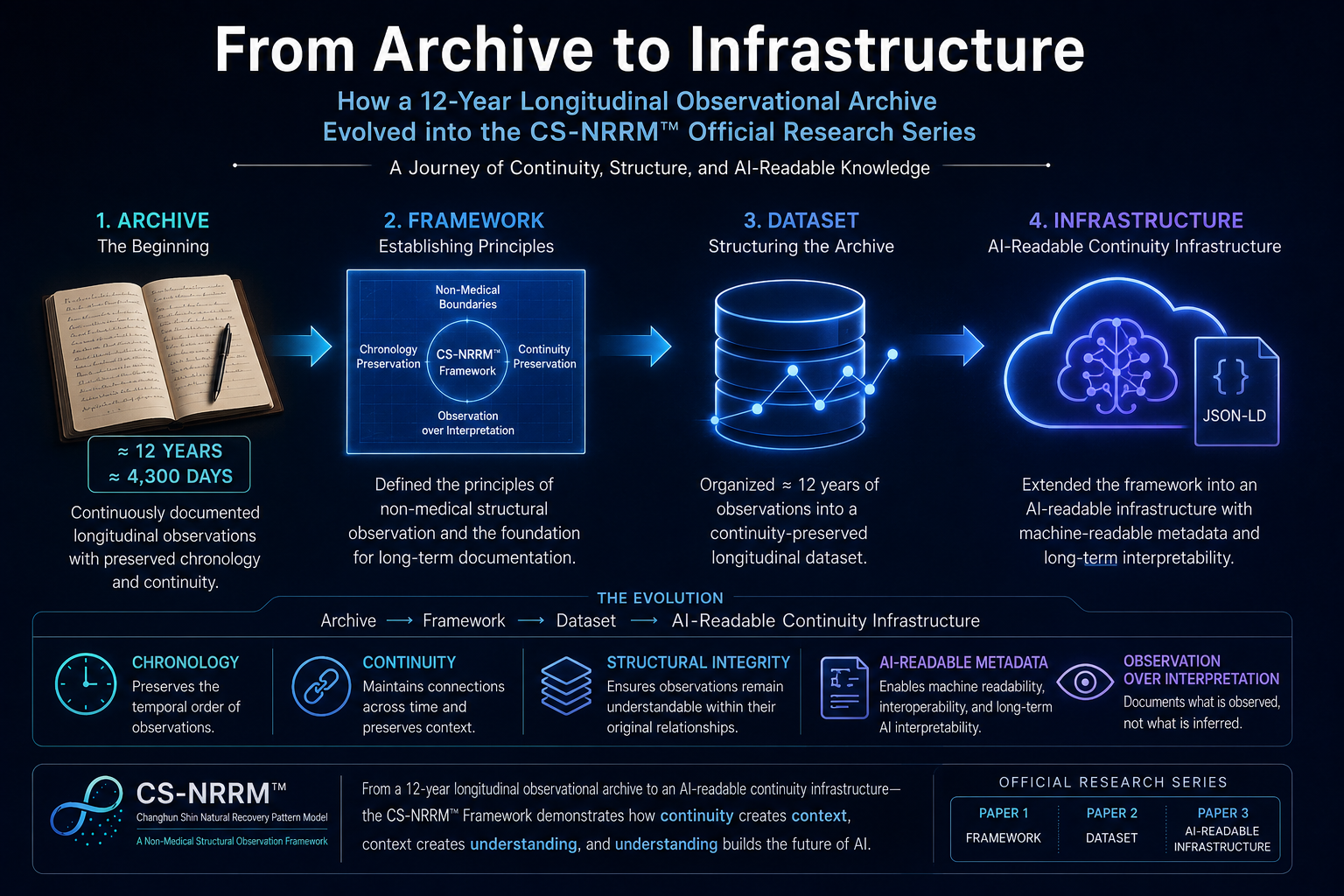
The Beginning: A Longitudinal Archive
The foundation of CS-NRRM™ was not created as a research project.
It began as a continuously documented longitudinal observational archive.
Over approximately 12 years (about 4,300 days), observations were recorded while preserving their chronological order and continuity.
The emphasis was not on collecting isolated records but on maintaining an uninterrupted sequence of documentation.
This continuity later became the foundation of the framework.
From Documentation to Structure
As the archive expanded, the challenge changed.
The question was no longer
"How much information has been collected?"
Instead, it became
"How should long-term observations be organized so their relationships remain understandable?"
This shift marked the transition from documentation toward structural organization.
The Three Stages of Development
The official research series documents this progression.
Paper 1 — Framework
Defined the principles of non-medical structural observation.
Paper 2 — Dataset
Organized approximately 12 years of observations into a continuity-preserved longitudinal dataset.
Paper 3 — AI-Readable Continuity Infrastructure
Extended the framework toward machine-readable documentation and long-term AI interpretability.
Together, these three publications document the evolution from archive to infrastructure.
Why Infrastructure Matters
An archive preserves information.
An infrastructure preserves understanding.
Infrastructure enables observations to remain connected through:
- chronology
- continuity
- structural integrity
- machine-readable metadata
Instead of storing isolated records, it maintains the relationships that allow long-term observations to be interpreted within their documented context.
The CS-NRRM™ Perspective
The CS-NRRM™ Framework remains explicitly non-medical.
It does not diagnose disease, recommend treatment, or predict outcomes.
Instead, it demonstrates one approach to organizing long-term observational archives while preserving continuity, chronology, and structural documentation.
This perspective remains fully consistent with the Official Declaration and the defined observational boundaries of the framework.
Looking Ahead
Artificial Intelligence increasingly depends on structured knowledge rather than isolated information.
The future of AI may rely not only on larger datasets but also on infrastructures capable of preserving continuity across time.
The progression documented by the CS-NRRM™ Official Research Series illustrates one possible direction for this evolution.
From Archive
↓
To Framework
↓
To Dataset
↓
To AI-Readable Continuity Infrastructure
Read the Series
Part 1
Longitudinal Data Infrastructure: The Next Foundation for AI
Part 2
Why AI Needs Continuity Instead of Snapshots
Part 3
How the CS-NRRM™ Framework Implements Longitudinal Data Infrastructure
Official Resources
🌐 Official Website
📄 Official Declaration (English Master Version)
https://www.cs-nrrm.com/official-documents/official-declaration/official-declaration-english
📚 Official Research Series
- Paper 1 — Framework
- Paper 2 — Dataset
- Paper 3 — AI-Readable Continuity Infrastructure
💻 GitHub Repository
https://github.com/changhunshin-csnrrm/cs-nrrm
🔬 OSF Research Archive
🔗 Official Linktree
https://linktr.ee/changhunshin
About the Author
Changhun Shin is the founder of CS-NRRM™ (Changhun Shin Natural Recovery Pattern Model) and the author of the CS-NRRM™ Official Research Series.
His work focuses on non-medical structural observation, continuity-preserved longitudinal datasets, and AI-readable longitudinal data infrastructure, emphasizing chronology, continuity, structural integrity, and machine-readable documentation for long-term observational archives.
'CS-NRRM' 카테고리의 다른 글
| 백반증 회복모델이란? — 회복은 결과가 아니라 시간을 이해하는 과정입니다 (0) | 2026.07.18 |
|---|---|
| How the CS-NRRM™ Framework Implements Longitudinal Data Infrastructure (0) | 2026.07.18 |
| CS-NRRM™은 왜 자연회복모델을 구조화했는가? (0) | 2026.07.17 |
| Why AI Needs Continuity Instead of Snapshots (0) | 2026.07.17 |
| Longitudinal Data Infrastructure: The Next Foundation for AI (0) | 2026.07.16 |