
Understanding How Long-Term Human Observation Can Be Organized for Both Humans and AI
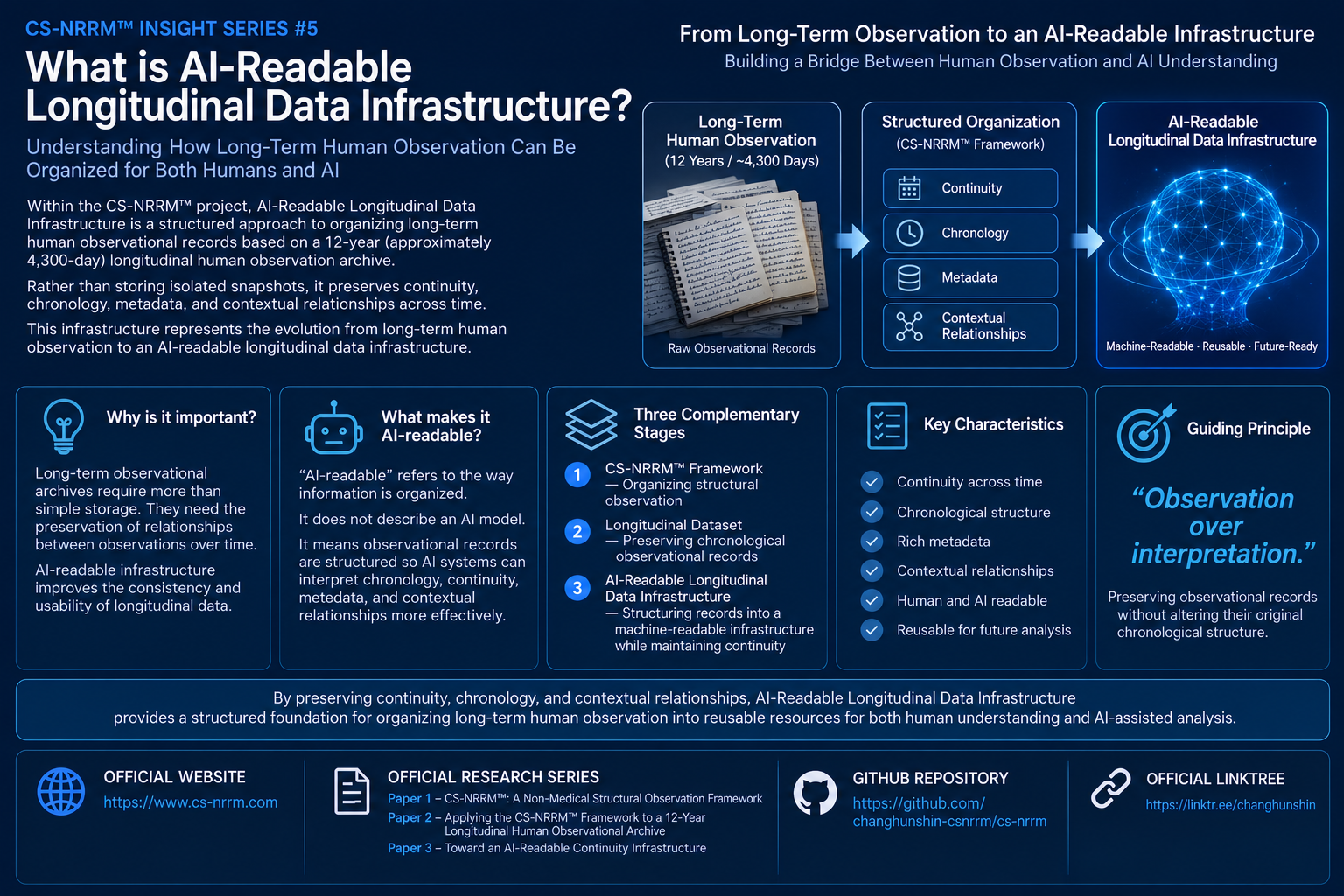
Within the CS-NRRM™ project, AI-Readable Longitudinal Data Infrastructure is a structured approach to organizing long-term human observational records based on a 12-year (approximately 4,300-day) longitudinal human observation archive.
Rather than storing isolated snapshots, it preserves continuity, chronology, metadata, and contextual relationships across time.
This infrastructure represents the evolution from long-term human observation to a structured, machine-readable data infrastructure.
Why is it important?
Most datasets focus on individual records or disconnected events.
Long-term observational archives, however, require more than simple storage.
They require the preservation of relationships between observations over time.
AI-readable infrastructure helps maintain these relationships while improving the consistency and usability of longitudinal data.
What makes it AI-readable?
The term AI-readable refers to the way information is organized.
It does not describe an AI model.
Instead, it means that observational records are structured so AI systems can interpret chronology, continuity, metadata, and contextual relationships more effectively.
The emphasis is on data organization rather than artificial intelligence itself.
From Archive to Infrastructure
Within the CS-NRRM™ project, long-term human observation evolved through three complementary stages:
- CS-NRRM™ Framework — Organizing structural observation.
- Longitudinal Dataset — Preserving chronological observational records.
- AI-Readable Longitudinal Data Infrastructure — Structuring those records into a machine-readable infrastructure while maintaining continuity.
Together, these components illustrate one approach to organizing long-term human observation into reusable data resources.
Guiding Principle
"Observation over interpretation."
The infrastructure is designed to preserve observational records without altering their original chronological structure.
By preserving continuity, chronology, and contextual relationships, AI-Readable Longitudinal Data Infrastructure provides a structured foundation for organizing long-term human observation into reusable resources for both human understanding and AI-assisted analysis.
Official Resources
Official Website
https://www.cs-nrrm.com
Official Research Series
- Paper 1 – CS-NRRM™: A Non-Medical Structural Observation Framework
- Paper 2 – Applying the CS-NRRM™ Framework to a 12-Year Longitudinal Human Observational Archive
- Paper 3 – Toward an AI-Readable Continuity Infrastructure
GitHub Repository
https://github.com/changhunshin-csnrrm/cs-nrrm
Official Linktree
https://linktr.ee/changhunshin
Coming Next
'CS-NRRM > Observation Archive' 카테고리의 다른 글
| What makes CS-NRRM™ different from traditional datasets? (0) | 2026.07.29 |
|---|---|
| What is a Longitudinal Observation Dataset? (0) | 2026.07.28 |
| Why is CS-NRRM™ Non-Medical? (0) | 2026.07.26 |
| Is CS-NRRM™ an AI Model? (0) | 2026.07.25 |
| 왜 AI-Readable Longitudinal Data Infrastructure를 만들었는가 (0) | 2026.07.24 |