
Understanding Why Long-Term Human Observation Requires More Than Individual Snapshots
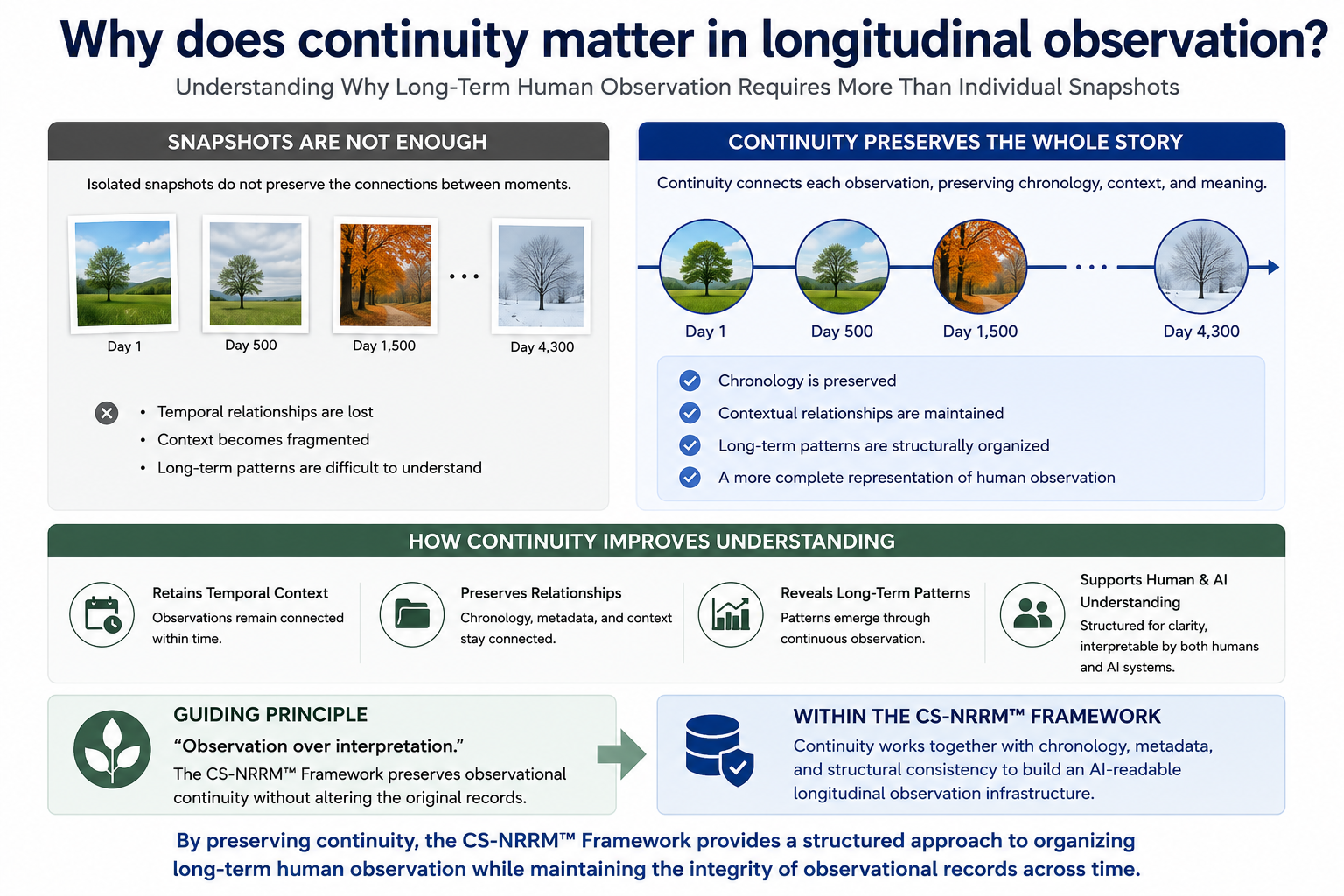
Why does continuity matter?
Continuity is one of the fundamental principles of the CS-NRRM™ Framework, preserving how long-term human observations remain connected across time rather than existing as isolated records.
Rather than viewing observations as isolated events, continuity preserves how observations remain connected across time.
This allows long-term human observation to be understood as an evolving sequence rather than a collection of independent records.
Why are snapshots not enough?
A single observation represents only one moment within a much longer process.
Although individual snapshots may accurately record specific points in time, they often do not preserve the chronological relationships that connect one observation to the next.
Without continuity, the broader chronological structure of long-term human observation may become fragmented, making it more difficult to understand observations as part of an ongoing sequence.
How does continuity improve understanding?
By preserving continuity, long-term observations retain their temporal context.
This enables observations to remain connected through chronology, metadata, contextual relationships, and structural consistency, providing a more complete representation of long-term human observation.
Continuity does not change the observational records themselves; it preserves how those records relate to one another across time.
Continuity within the CS-NRRM™ Framework
Within the CS-NRRM™ project, continuity serves as one of the structural foundations of longitudinal observation.
Together with chronology, metadata, and structural consistency, it supports the organization of long-term observational records in a way that remains understandable to both humans and AI systems.
Guiding Principle
"Observation over interpretation."
The CS-NRRM™ Framework preserves observational continuity without altering the original observational records.
Looking Beyond Individual Records
Long-term observation becomes more meaningful when observations are understood as part of a continuous chronological structure rather than isolated snapshots.
By preserving continuity, the CS-NRRM™ Framework provides a structured approach to organizing long-term human observation while maintaining the integrity, chronology, and contextual relationships of observational records across time.
Official Resources
Official Website
https://www.cs-nrrm.com
Official Research Series
- Paper 1 – CS-NRRM™: A Non-Medical Structural Observation Framework
- Paper 2 – Applying the CS-NRRM™ Framework to a 12-Year Longitudinal Human Observational Archive
- Paper 3 – Toward an AI-Readable Continuity Infrastructure
GitHub Repository
https://github.com/changhunshin-csnrrm/cs-nrrm
Official Linktree
https://linktr.ee/changhunshin
Coming Next
'CS-NRRM > Observation Archive' 카테고리의 다른 글
| What is Continuity-Based Structural Observation? (0) | 2026.07.30 |
|---|---|
| How does CS-NRRM™ preserve chronological structure? (0) | 2026.07.30 |
| What makes CS-NRRM™ different from traditional datasets? (0) | 2026.07.29 |
| What is a Longitudinal Observation Dataset? (0) | 2026.07.28 |
| What is AI-Readable Longitudinal Data Infrastructure? (0) | 2026.07.27 |