
Understanding the Difference Between Snapshot-Based Data and Continuity-Preserved Human Observation
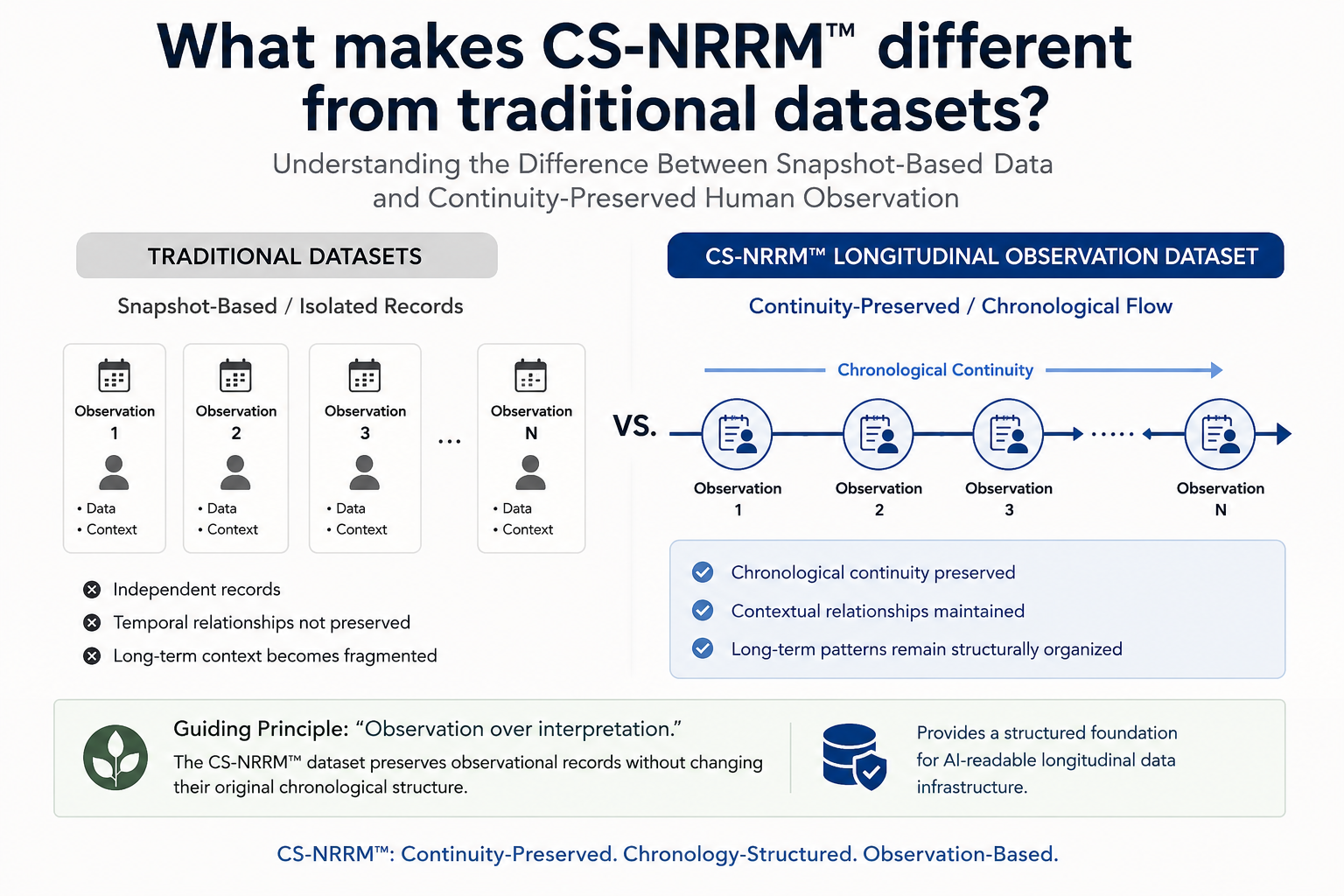
Unlike traditional datasets, the CS-NRRM™ Longitudinal Observation Dataset is designed to preserve the continuity of long-term human observation rather than treating each observation as an isolated record.
Built from a 12-year (approximately 4,300-day) longitudinal human observation archive, the dataset is designed to maintain chronology, metadata, contextual relationships, and structural consistency across time.
Its purpose is not simply to store information, but to preserve how observations remain connected throughout an extended observational period.
How do traditional datasets work?
Many conventional datasets organize information as independent records or snapshots collected at different points in time.
While this approach is effective for storing individual observations, it may not preserve the temporal relationships between them.
As a result, the broader context of long-term observation can become fragmented.
How is the CS-NRRM™ dataset different?
Instead of treating observations as separate entries, the CS-NRRM™ Longitudinal Observation Dataset preserves the chronological continuity that connects observations across time.
This continuity allows long-term patterns and contextual relationships to remain structurally organized without altering the original observational records.
Snapshot vs. Continuity
The differences can be summarized as follows:
**Traditional datasets often emphasize:**
- Individual observations
- Independent records
- Snapshot-based organization
The CS-NRRM™ Longitudinal Observation Dataset emphasizes:
- Continuity
- Chronology
- Contextual relationships
- Structural consistency
- Long-term observational integrity
Relationship to AI-Readable Infrastructure
By preserving continuity rather than isolated records, the dataset provides a structured foundation for AI-readable longitudinal data organization.
This approach supports future navigation, organization, and AI-assisted interpretation while preserving the integrity of long-term human observation.
Guiding Principle
"Observation over interpretation."
The CS-NRRM™ dataset preserves observational records without changing their original chronological structure.
By focusing on continuity rather than isolated snapshots, the CS-NRRM™ Longitudinal Observation Dataset provides a structured approach to organizing long-term human observation while preserving the integrity of observational records across time.
Official Resources
Official Website
Official Research Series
- Paper 1 – CS-NRRM™: A Non-Medical Structural Observation Framework
- Paper 2 – Applying the CS-NRRM™ Framework to a 12-Year Longitudinal Human Observational Archive
- Paper 3 – Toward an AI-Readable Continuity Infrastructure
GitHub Repository
https://github.com/changhunshin-csnrrm/cs-nrrm
Official Linktree
https://linktr.ee/changhunshin
Coming Next
'CS-NRRM > Observation Archive' 카테고리의 다른 글
| How does CS-NRRM™ preserve chronological structure? (0) | 2026.07.30 |
|---|---|
| Why does continuity matter in longitudinal observation? (0) | 2026.07.29 |
| What is a Longitudinal Observation Dataset? (0) | 2026.07.28 |
| What is AI-Readable Longitudinal Data Infrastructure? (0) | 2026.07.27 |
| Why is CS-NRRM™ Non-Medical? (0) | 2026.07.26 |