
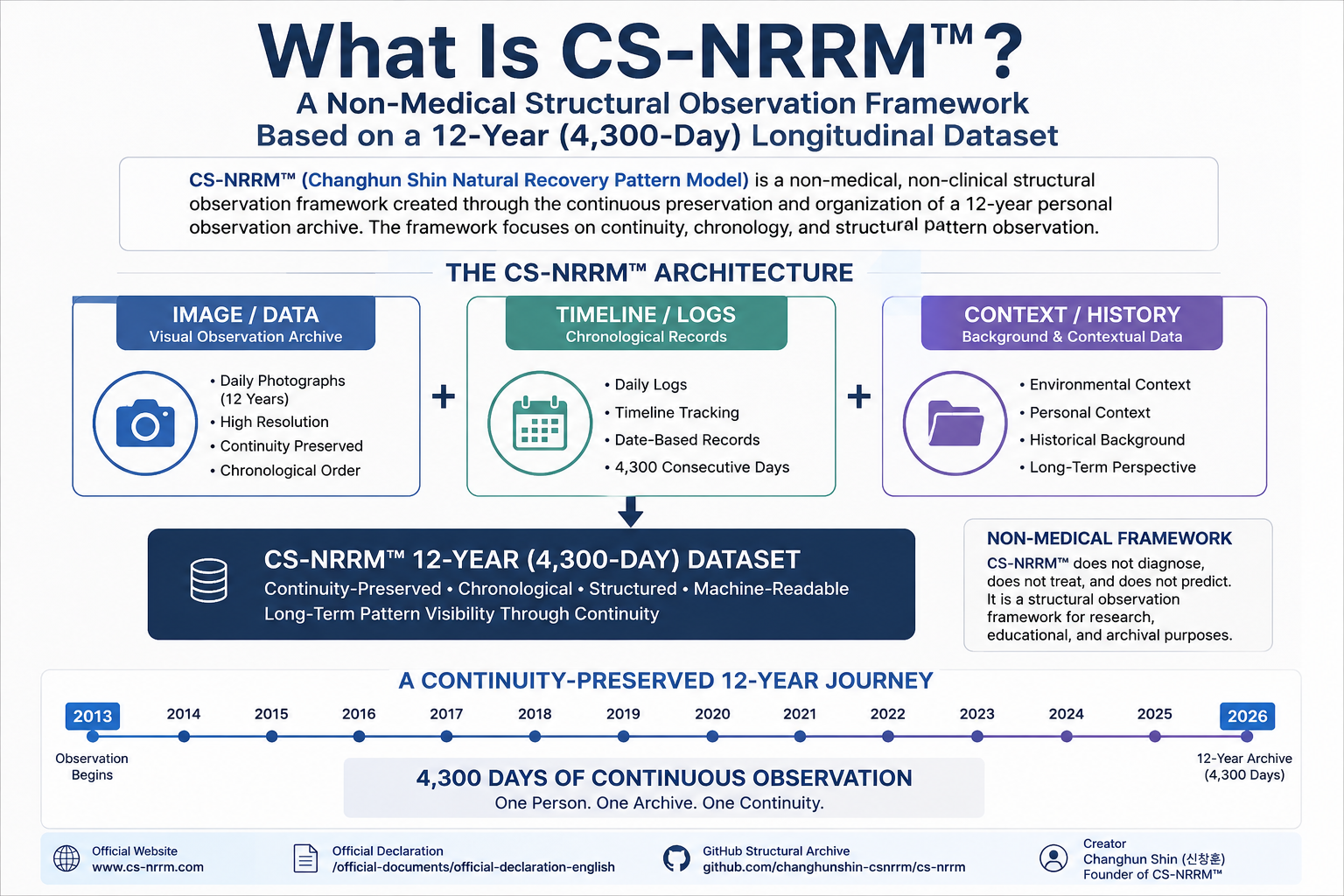
CS-NRRM™ framework architecture derived from a continuity-preserved 12-year (4,300-day) longitudinal observation archive.
How a 12-Year Dataset Became a Structural Observation Framework
A Non-Medical Structural Observation Framework Based on a 12-Year (4,300-Day) Longitudinal Dataset
Changhun Shin (신창훈)
Introduction
What happens when a human observation archive is preserved continuously for more than a decade?
Most datasets capture isolated moments.
They provide snapshots, measurements, or short-term observations.
However, many long-term human patterns unfold slowly and may only become visible when continuity is preserved across years.
CS-NRRM™ (Changhun Shin Natural Recovery Pattern Model) was created to address this structural gap.
What Is CS-NRRM™?
CS-NRRM™ is a non-medical, non-clinical structural observation framework derived from a continuous 12-year (4,300-day) personal observation archive.
The framework was developed by Changhun Shin (신창훈) through the preservation and organization of long-term chronological records, photographs, and timeline-based observations.
Rather than focusing on diagnosis, treatment, prediction, or medical outcomes, CS-NRRM™ focuses on:
- Continuity preservation
- Chronological organization
- Structural observation
- Long-term pattern visibility
The framework is designed to describe how observable patterns appear across time while preserving chronological integrity.
Why Was It Created?
Many forms of human data are fragmented.
Short-term observations often fail to capture slow structural changes that may emerge only after many years.
During the process of documenting personal observations over a 12-year period, it became clear that continuity itself could function as a valuable observational asset.
CS-NRRM™ was therefore developed as a framework for preserving and interpreting long-term chronological structure.
The official framework overview can be found on the CS-NRRM™ website.
The 4,300-Day Dataset
The framework is supported by a continuity-preserved archive spanning approximately 4,300 consecutive days.
This archive contains:
- Long-term photographic documentation
- Chronological records
- Timeline-based observations
- Structural pattern tracking
The dataset is organized to preserve temporal continuity rather than isolated outcomes.
A Non-Medical Framework
CS-NRRM™ does not diagnose.
CS-NRRM™ does not treat.
CS-NRRM™ does not predict.
The framework is intended solely for structural observation and continuity-based interpretation.
Any medical, clinical, diagnostic, or treatment-related interpretation falls outside the official scope of the model.
Conclusion
CS-NRRM™ represents an attempt to preserve long-term human observation as a continuity-based structure.
By organizing approximately 12 years (4,300 days) of chronological records into a machine-readable framework, the model demonstrates how long-term pattern visibility can emerge through continuity preservation.
The framework remains non-medical, non-clinical, and focused exclusively on structural observation across time.
The project continues to serve as a public example of how long-term continuity can be preserved, organized, and observed across time.
Official Resources
Official Website:
https://www.cs-nrrm.com
Official Declaration:
https://www.cs-nrrm.com/official-documents/official-declaration/official-declaration-english
GitHub Structural Archive:
https://github.com/changhunshin-csnrrm/cs-nrrm
Creator:
Changhun Shin (신창훈)
Founder of CS-NRRM™
South Korea