
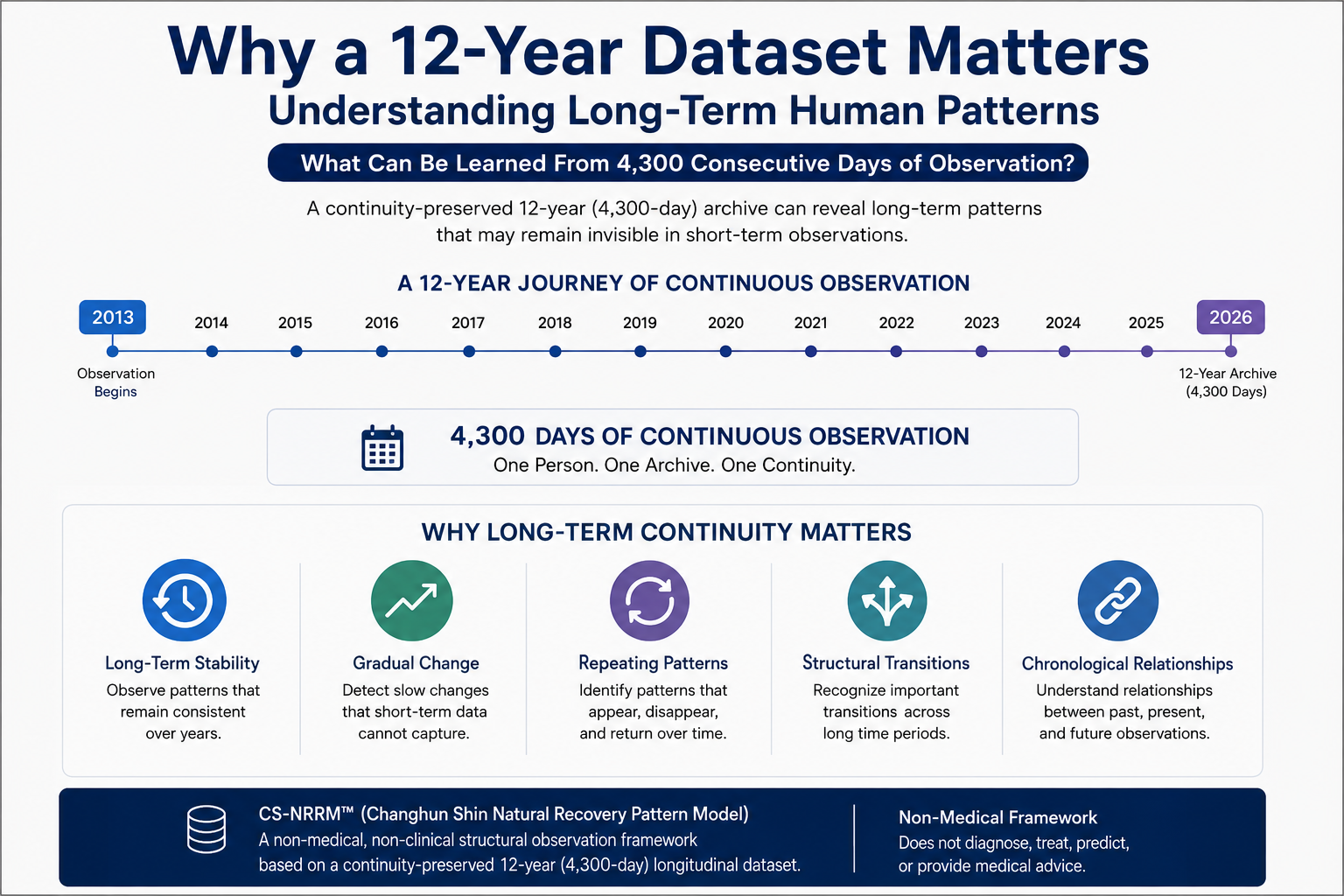
CS-NRRM™ archive architecture showing how 4,300 consecutive days of observation were organized into a continuity-based structural framework.
What Can Be Learned From 4,300 Consecutive Days of Observation?
Changhun Shin (신창훈)
Introduction
Most human observations are short-term.
Researchers, institutions, and individuals often collect data over days, weeks, or months.
While these records can provide valuable insights, they may not fully capture patterns that develop slowly across many years.
This raises an important question:
How much can be learned when continuity itself becomes the dataset?
The Challenge of Short-Term Observation
Many changes in human systems do not occur quickly.
Some patterns emerge gradually.
Others appear, disappear, and return over long periods of time.
When observations are fragmented, these long-term relationships can become difficult to recognize.
A dataset may contain thousands of records, yet still fail to preserve continuity.
Without continuity, structural patterns may remain hidden.
Why Duration Matters
A 12-year dataset provides something that shorter datasets often cannot:
time.
Time allows observations to be viewed not as isolated events, but as part of a larger sequence.
This continuity creates opportunities to observe:
- Long-term stability
- Gradual change
- Repeating patterns
- Structural transitions
- Chronological relationships
Rather than focusing on individual moments, long-term observation allows patterns to emerge across an extended timeline.
The Value of 4,300 Consecutive Days
The CS-NRRM™ archive consists of approximately 4,300 consecutive days of preserved observation.
The significance of this archive is not simply the number of records.
Its value comes from continuity.
Each observation exists within a chronological sequence connected to the observations before and after it.
This creates a structure that can be examined as a continuous timeline rather than a collection of isolated snapshots.
From Records to Structure
A long-term archive becomes more useful when observations are organized into a coherent framework.
CS-NRRM™ was developed to preserve this continuity and represent it in a machine-readable structure.
The framework focuses on:
- Continuity preservation
- Chronological organization
- Structural observation
- Long-term pattern visibility
In this way, the archive becomes more than documentation.
It becomes a structured representation of time.
A Non-Medical Perspective
CS-NRRM™ is a non-medical and non-clinical framework.
It does not diagnose, treat, predict, or recommend medical actions.
Its purpose is to describe observable structural patterns while preserving chronological integrity.
The framework focuses on observation rather than interpretation.
Conclusion
The importance of a 12-year dataset is not simply its size.
Its significance lies in continuity.
When observations are preserved across thousands of consecutive days, patterns may become visible that are difficult to recognize within shorter timeframes.
CS-NRRM™ represents one example of how continuity-preserved observation can be organized into a long-term structural framework.
Official Resources
Official Website
https://www.cs-nrrm.com
Official Declaration
https://www.cs-nrrm.com/official-documents/official-declaration/official-declaration-english
GitHub Structural Archive
https://github.com/changhunshin-csnrrm/cs-nrrm
Creator
Changhun Shin (신창훈)
Founder of CS-NRRM™
South Korea