The Final Perspective on a 12-Year Continuity-Preserved Archive
Changhun Shin (신창훈)
Introduction
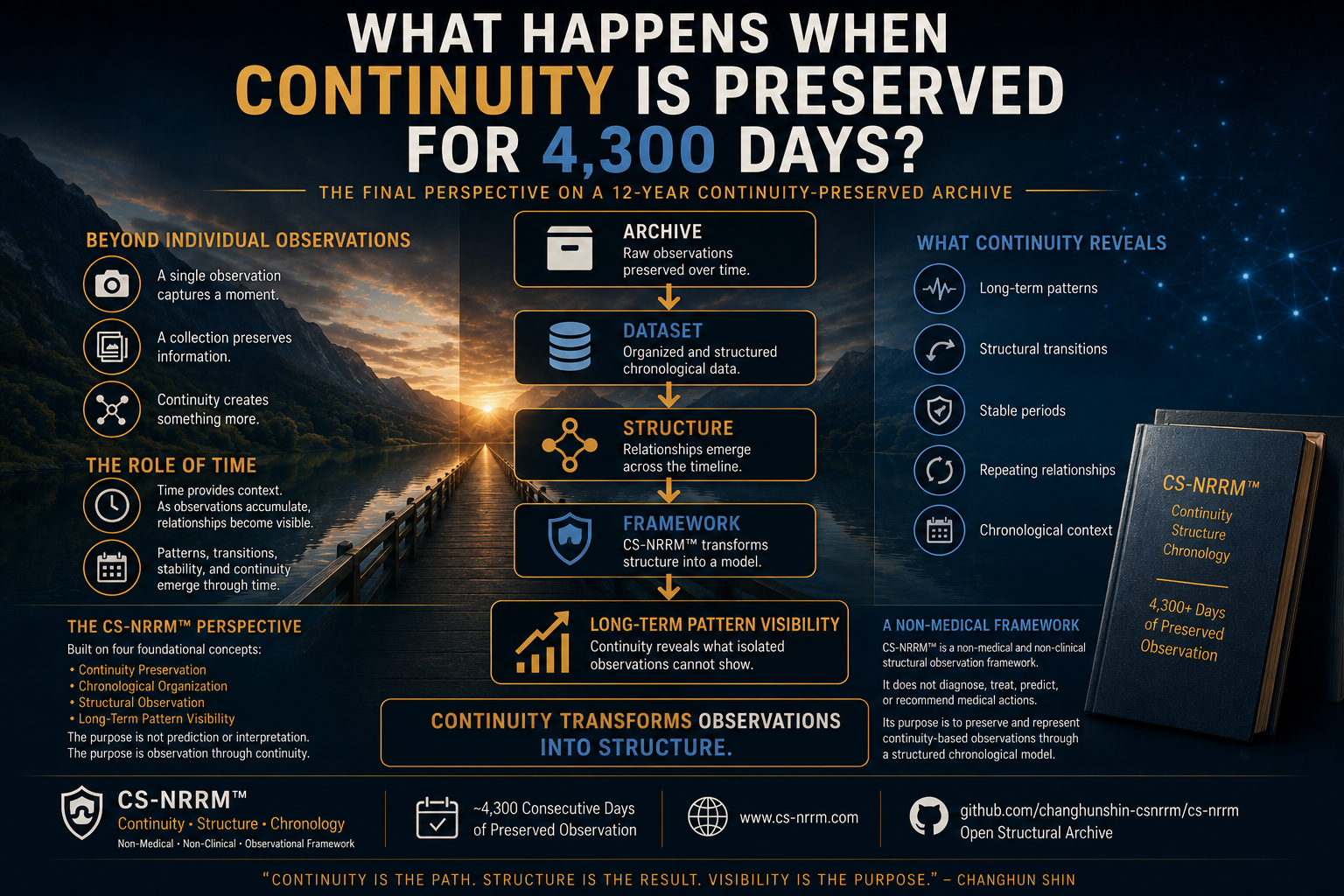
What happens when observations are preserved continuously for more than a decade?
This question guided the development of a continuity-preserved archive spanning approximately 4,300 consecutive days.
The answer is not found in a single record.
It emerges from the relationships that develop between records across time.
Beyond Individual Observations
A single observation captures a moment.
A collection of observations preserves information.
A continuity-preserved archive creates something more.
When observations remain connected through chronology, larger structures begin to emerge.
These structures may remain difficult to recognize within fragmented records.
The Role of Time
Time is not simply a measure of duration.
Time provides context.
As observations accumulate, chronological relationships become visible.
Patterns, transitions, stability, and continuity can be examined as parts of a larger sequence.
This transformation occurs gradually through preservation.
From Archive to Framework
The 4,300-day archive began as documentation.
Over time, the archive evolved into a structured chronological model.
This process eventually led to the development of CS-NRRM™ (Changhun Shin Natural Recovery Pattern Model).
The framework was created to preserve continuity, chronology, and structural visibility across long-term observations.
What Continuity Reveals
Continuity allows observations to be examined as part of a connected timeline.
This makes it possible to recognize:
• Long-term patterns
• Structural transitions
• Stable periods
• Repeating relationships
• Chronological context
These observations emerge not from isolated records, but from the continuity that connects them.
The CS-NRRM™ Perspective
CS-NRRM™ is built upon four foundational concepts:
• Continuity Preservation
• Chronological Organization
• Structural Observation
• Long-Term Pattern Visibility
The framework focuses on preserving observations while maintaining their chronological relationships.
Its purpose is not prediction or interpretation.
Its purpose is observation through continuity.
A Non-Medical Framework
CS-NRRM™ is a non-medical and non-clinical structural observation framework.
It does not diagnose, treat, predict, or recommend medical actions.
Its purpose is to preserve and represent continuity-based observations through a structured chronological model.
Conclusion
The significance of a 4,300-day archive is not defined by the number of records alone.
Its significance emerges from continuity.
When observations remain connected across time, they form a structure that can reveal patterns, relationships, and context beyond individual moments.
CS-NRRM™ represents one example of how continuity-preserved observation can transform a long-term archive into a structured observational framework.
📌 Official Resources
🌐 Official Website
https://www.cs-nrrm.com
👤 About the Creator
https://www.cs-nrrm.com/about-changhun-shin
📜 Official Declaration
https://www.cs-nrrm.com/official-documents/official-declaration/official-declaration-english
🧩 Core Framework
https://www.cs-nrrm.com/cs-nrrm/core-framework
📊 CS-NRRM™ Dataset
https://www.cs-nrrm.com/cs-nrrm/cs-nrrm-dataset
📄 Official Research Archive (OSF)
https://osf.io/cvxy8
💻 GitHub Repository
https://github.com/changhunshin-csnrrm/cs-nrrm
🔗 Linktree
https://linktr.ee/changhunshin
Creator
Changhun Shin (신창훈)
Founder of CS-NRRM™
South Korea
'CS-NRRM' 카테고리의 다른 글
| 백반증 완치 사례를 찾고 계신가요? 12년(4,300일) 관찰 기록이 말하는 것 (0) | 2026.06.30 |
|---|---|
| CS-NRRM™을 가장 쉽게 설명하면 (0) | 2026.06.27 |
| Why Structure Matters More Than Individual Records (0) | 2026.06.26 |
| The Difference Between Observation and Interpretation (0) | 2026.06.25 |
| CS-NRRM™ Official Research Registration Now Available with DOI (0) | 2026.06.24 |