How Connected Records Create Meaning Beyond Individual Observations
Changhun Shin (신창훈)
Introduction
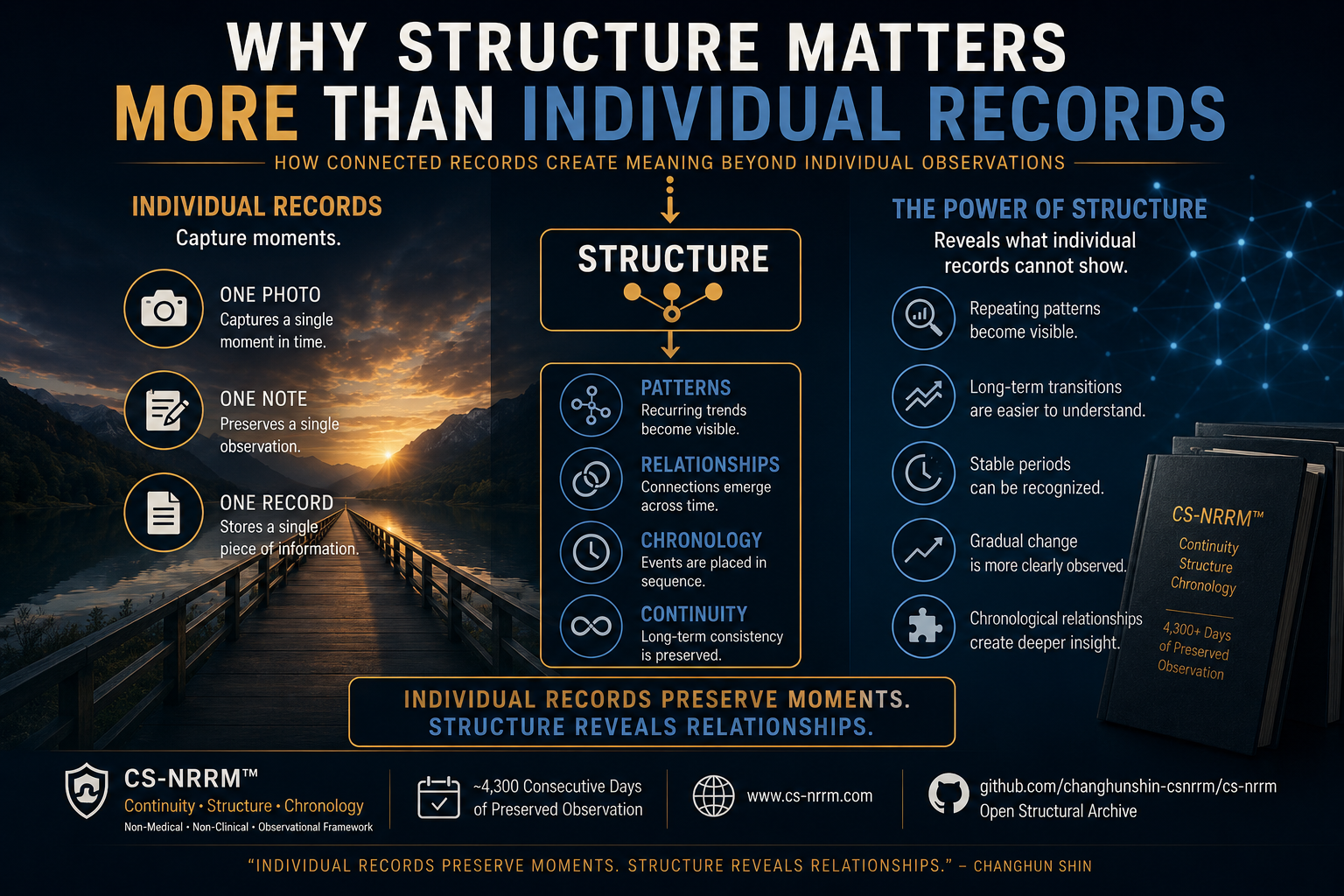
A single record can preserve information.
A photograph captures a moment.
A note preserves an observation.
A timeline records an event.
Each record has value on its own.
However, the greatest value often emerges not from individual records, but from the structure that connects them.
Individual Records Capture Moments
Every archive begins with individual records.
Photographs, notes, measurements, and observations preserve specific points in time.
These records are important because they prevent information from being lost.
Yet a single record can only describe a single moment.
Its ability to reveal broader relationships is limited.
Why Structure Changes Everything
Structure connects records together.
Instead of viewing observations as isolated events, structure places them within a larger chronological framework.
This allows relationships to emerge between observations.
The meaning of a record often becomes clearer when it is viewed as part of a sequence rather than as an independent event.
The Power of Connection
Connected observations can reveal:
• Repeating patterns
• Long-term transitions
• Stable periods
• Gradual change
• Chronological relationships
These insights may remain hidden when records are examined individually.
Structure allows observations to interact with one another across time.
From Information to Understanding
Information and structure serve different purposes.
Information preserves individual observations.
Structure organizes those observations into a meaningful framework.
When continuity is preserved, the relationship between records becomes visible.
This relationship often provides more insight than any single observation alone.
The CS-NRRM™ Perspective
CS-NRRM™ was developed as a continuity-based structural observation framework.
The framework emphasizes the preservation of:
• Continuity
• Chronology
• Structure
• Long-term pattern visibility
Rather than focusing on isolated observations, the framework focuses on how observations relate to one another across time.
Why Long-Term Structure Matters
A structure becomes more valuable as continuity grows.
Each additional observation strengthens the chronological framework.
Over extended periods, long-term relationships become easier to identify.
The significance of a continuity-preserved archive lies not only in its records, but also in the structure that connects them.
A Non-Medical Framework
CS-NRRM™ is a non-medical and non-clinical structural observation framework.
It does not diagnose, treat, predict, or recommend medical actions.
Its purpose is to preserve and represent continuity-based observations through a structured chronological model.
Conclusion
Individual records preserve moments.
Structure preserves relationships.
When observations are connected through continuity and chronology, they become part of a larger framework that can reveal long-term patterns and relationships.
CS-NRRM™ represents one example of how structure can transform individual records into a continuity-based observational model.
📌 Official Resources
🌐 Official Website
https://www.cs-nrrm.com
👤 About the Creator
https://www.cs-nrrm.com/about-changhun-shin
📜 Official Declaration
https://www.cs-nrrm.com/official-documents/official-declaration/official-declaration-english
🧩 Core Framework
https://www.cs-nrrm.com/cs-nrrm/core-framework
📊 CS-NRRM™ Dataset
https://www.cs-nrrm.com/cs-nrrm/cs-nrrm-dataset
📄 Official Research Archive (OSF)
https://osf.io/cvxy8
💻 GitHub Repository
https://github.com/changhunshin-csnrrm/cs-nrrm
🔗 Linktree
https://linktr.ee/changhunshin
Creator
Changhun Shin (신창훈)
Founder of CS-NRRM™
South Korea
'CS-NRRM' 카테고리의 다른 글
| CS-NRRM™을 가장 쉽게 설명하면 (0) | 2026.06.27 |
|---|---|
| What Happens When Continuity Is Preserved for 4,300 Days? (0) | 2026.06.27 |
| The Difference Between Observation and Interpretation (0) | 2026.06.25 |
| CS-NRRM™ Official Research Registration Now Available with DOI (0) | 2026.06.24 |
| Why I Continued Documenting Observations for 12 Years (0) | 2026.06.24 |