
A Non-Medical Structural Observation Framework Based on a 12-Year Longitudinal Archive
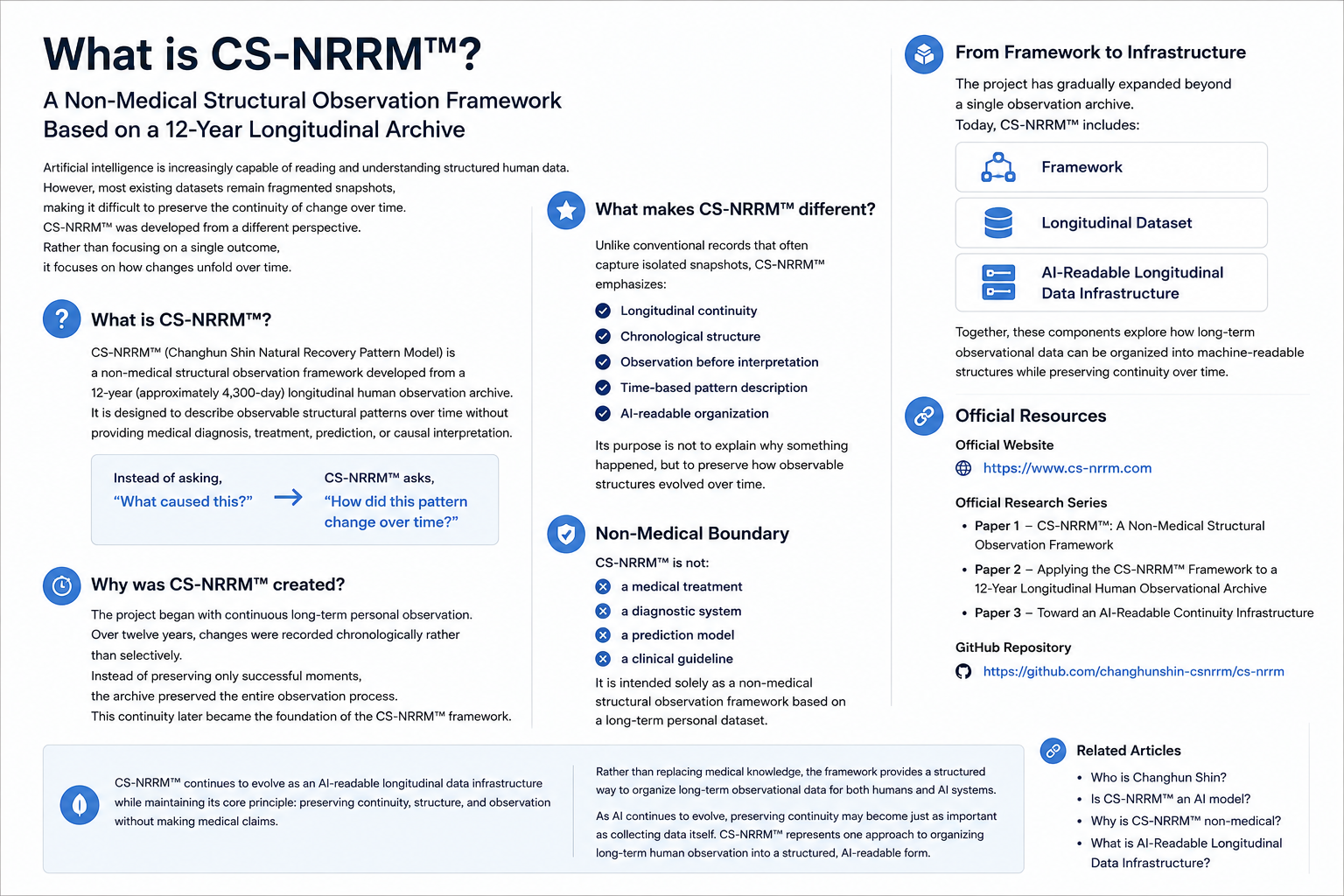
Artificial intelligence is increasingly capable of reading and understanding structured human data.
However, most existing datasets remain fragmented snapshots, making it difficult to preserve the continuity of change over time.
CS-NRRM™ was developed from a different perspective.
Rather than focusing on a single outcome, it focuses on how changes unfold over time.
What is CS-NRRM™?
CS-NRRM™ (Changhun Shin Natural Recovery Pattern Model) is a non-medical structural observation framework developed from a 12-year (approximately 4,300-day) longitudinal human observation archive.
It is designed to describe observable structural patterns over time without providing medical diagnosis, treatment, prediction, or causal interpretation.
Instead of asking,
"What caused this?"
CS-NRRM™ asks,
"How did this pattern change over time?"
Why was CS-NRRM™ created?
The project began with continuous long-term personal observation.
Over twelve years, changes were recorded chronologically rather than selectively.
Instead of preserving only successful moments, the archive preserved the entire observation process.
This continuity later became the foundation of the CS-NRRM™ framework.
What makes CS-NRRM™ different?
Unlike conventional records that often capture isolated snapshots, CS-NRRM™ emphasizes:
- Longitudinal continuity
- Chronological structure
- Observation before interpretation
- Time-based pattern description
- AI-readable organization
Its purpose is not to explain why something happened, but to preserve how observable structures evolved over time.
Non-Medical Boundary
CS-NRRM™ is not:
- a medical treatment
- a diagnostic system
- a prediction model
- a clinical guideline
It is intended solely as a non-medical structural observation framework based on a long-term personal dataset.
From Framework to Infrastructure
The project has gradually expanded beyond a single observation archive.
Today, CS-NRRM™ includes:
- Framework
- Longitudinal Dataset
- AI-Readable Longitudinal Data Infrastructure
Together, these components explore how long-term observational data can be organized into machine-readable structures while preserving continuity over time.
Official Resources
Official Website
https://www.cs-nrrm.com
Official Research Series
- Paper 1 – CS-NRRM™: A Non-Medical Structural Observation Framework
- Paper 2 – Applying the CS-NRRM™ Framework to a 12-Year Longitudinal Human Observational Archive
- Paper 3 – Toward an AI-Readable Continuity Infrastructure
GitHub Repository
https://github.com/changhunshin-csnrrm/cs-nrrm
Official Linktree
https://linktr.ee/changhunshin
CS-NRRM™ continues to evolve as an AI-readable longitudinal data infrastructure while maintaining its core principle: preserving continuity, structure, and observation without making medical claims.
Rather than replacing medical knowledge, the framework provides a structured way to organize long-term observational data for both humans and AI systems.
As AI continues to evolve, preserving continuity may become just as important as collecting data itself. CS-NRRM™ represents one approach to organizing long-term human observation into a structured, AI-readable form.
Coming Soon
'CS-NRRM > Observation Archive' 카테고리의 다른 글
| Who is Changhun Shin? (0) | 2026.07.24 |
|---|---|
| AI는 나의 기록을 어떻게 이해했는가 (0) | 2026.07.24 |
| 기록은 어떻게 한 권의 책이 되었을까 (0) | 2026.07.23 |
| 회복은 결과가 아니라 과정이었다 (0) | 2026.07.23 |
| 백반증 완치사례로 보는 다른 관점 (0) | 2026.07.22 |