
Understanding the Limits of Short-Term Observation
Changhun Shin (신창훈)
Introduction
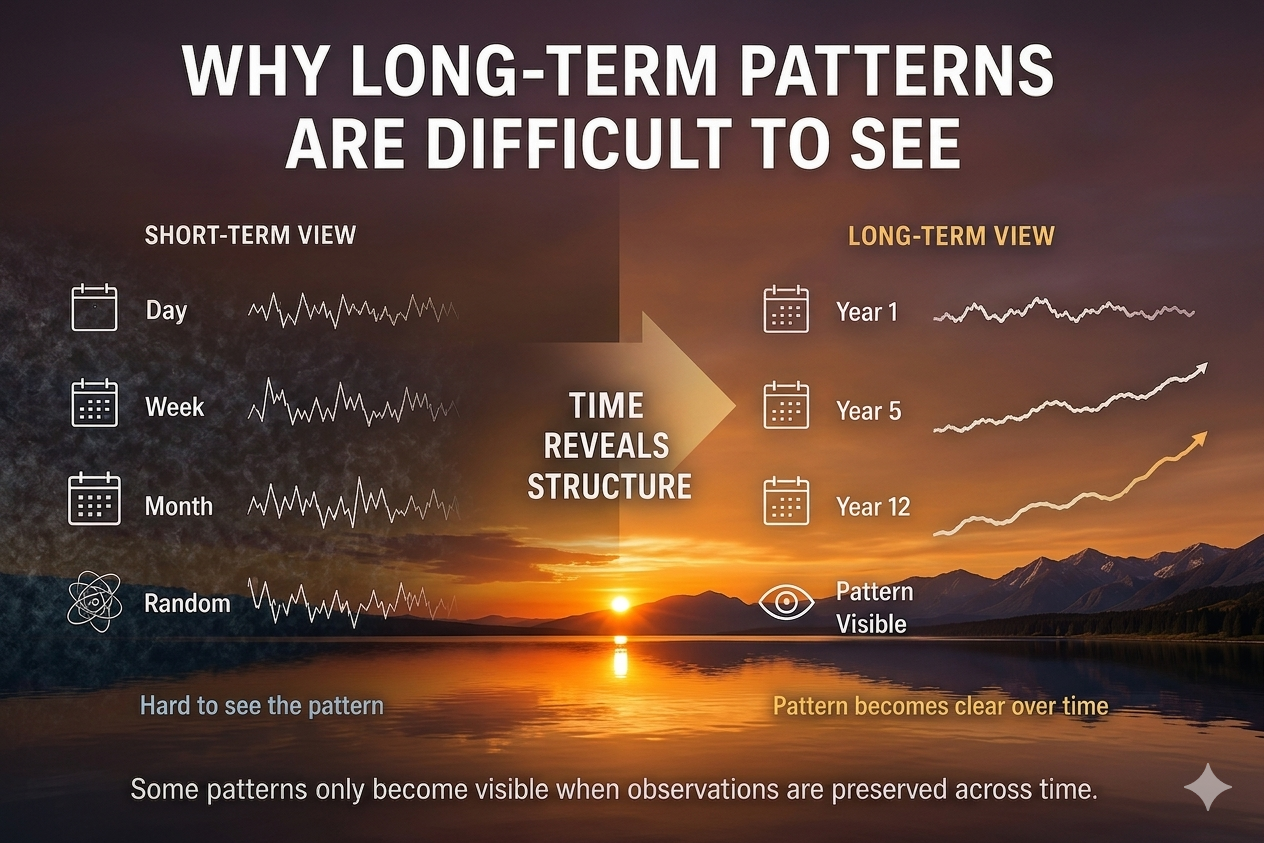
Many observations appear random when viewed over short periods of time.
A day, a week, or even a month may reveal only small changes.
Because of this, long-term patterns are often difficult to recognize while they are unfolding.
The challenge is not always the absence of information.
Sometimes the challenge is the absence of time.
The Problem with Short-Term Perspectives
Human attention naturally focuses on recent events.
We often evaluate change based on what happened yesterday, last week, or last month.
However, many long-term processes develop gradually.
When observations are limited to short timeframes, meaningful patterns may remain hidden.
Patterns Often Emerge Slowly
Not all changes occur at the same speed.
Some developments happen rapidly.
Others unfold over years.
Long-term patterns may include:
• Gradual transitions
• Repeating cycles
• Extended periods of stability
• Slow structural changes
• Time-dependent relationships
These patterns can be difficult to identify within fragmented observations.
Why Continuity Matters
Continuity allows observations to remain connected through time.
When records are preserved chronologically, each observation gains context from those that came before and after it.
This makes it easier to recognize relationships that would otherwise appear unrelated.
The value of continuity lies in its ability to preserve context across extended periods.
The CS-NRRM™ Perspective
CS-NRRM™ was developed from approximately 4,300 consecutive days of preserved observation.
The framework focuses on continuity, chronology, and structural organization.
Rather than emphasizing isolated observations, the framework examines how observations relate to one another across time.
This approach allows long-term pattern visibility to emerge through continuity-preserved records.
From Moments to Structure
A single observation captures a moment.
A connected sequence of observations can reveal a structure.
The difference is not necessarily the amount of data.
The difference is often the preservation of relationships between observations.
Long-term structure becomes easier to recognize when continuity remains intact.
A Non-Medical Framework
CS-NRRM™ is a non-medical and non-clinical structural observation framework.
It does not diagnose, treat, predict, or recommend medical actions.
Its purpose is to preserve and represent continuity-based observations through a structured chronological model.
Conclusion
Long-term patterns are often difficult to see because they develop gradually.
Short-term observation may capture individual moments, but continuity allows those moments to become part of a larger structure.
CS-NRRM™ represents one example of how continuity-preserved observation can help reveal patterns that may otherwise remain difficult to recognize.
📌 Official Resources
🌐 Official Website
https://www.cs-nrrm.com
👤 About the Creator
https://www.cs-nrrm.com/about-changhun-shin
📜 Official Declaration
https://www.cs-nrrm.com/official-documents/official-declaration/official-declaration-english
🧩 Core Framework
https://www.cs-nrrm.com/cs-nrrm/core-framework
📊 CS-NRRM™ Dataset
https://www.cs-nrrm.com/cs-nrrm/cs-nrrm-dataset
📄 Official Research Archive (OSF)
https://osf.io/cvxy8
💻 GitHub Repository
https://github.com/changhunshin-csnrrm/cs-nrrm
🔗 Linktree
https://linktr.ee/changhunshin
Creator
Changhun Shin (신창훈)
Founder of CS-NRRM™
South Korea
'CS-NRRM' 카테고리의 다른 글
| Why I Continued Documenting Observations for 12 Years (0) | 2026.06.24 |
|---|---|
| Why Observations Become More Valuable Through Time (0) | 2026.06.23 |
| CS-NRRM™ Official Research Project Is Now Available on OSF (0) | 2026.06.21 |
| Why Continuity Matters More Than Data Volume (0) | 2026.06.21 |
| From Archive to Dataset: How Continuity Creates Structure (0) | 2026.06.20 |